
Subscription retry policies decide what a payment platform does when a merchant's rebill is declined: which decline codes are retried, how far apart, and what happens to the subscription after the last attempt. For a PSP, PayFac or ISV, one rule matters more than the rest, and many billing tools break it: the next billing date must not move.
A failed checkout is a conversation with a customer still on the page. A failed rebill is a transaction nobody is watching, on a saved card, inside a schedule that promised the merchant a payment on a fixed date. NORBr's Subscriptions module gives operators retry policies built for rebills, chosen per decline by a decision tree, the Retry matrix, under the operator's own brand.
Card schemes now enforce that distinction. Since 2021, Visa caps reattempts on a declined transaction and Mastercard tells merchants, code by code, whether and when to try again; the fees for ignoring them land on the acquiring side of the platform.
Why does a failed rebill behave differently from a failed checkout?
A rebill is a merchant-initiated transaction on a stored credential, so there is no customer to ask for another card, and it belongs to a schedule, so every retry is measured against a date rather than a session. Retrying a rebill is a question of calendar and of decline code.
At checkout, the customer fixes a decline on the spot. On a rebill, the customer is absent, the card may have expired or been reissued since the first payment, and the platform's only signals are the issuer's response code and the scheme's advice code. Those two signals, and the position of the failure in the billing cycle, are all a retry policy has to work with.
The largest subscription businesses describe their retries in these terms. Netflix states that it "will automatically retry failed payments periodically during the course of your billing cycle" and holds the account in the meantime; Spotify tells subscribers that a failed monthly payment does not end Premium at once and that it "will try to take the payment again over the next few days". Both retry inside the current billing cycle rather than opening a new one.
What do Visa and Mastercard allow when a rebill is declined?
Both schemes classify declines and cap reattempts. Visa groups response codes into categories (three in its 2021 rules, four in current acquirer guides) and allows up to 15 reattempts in a rolling 30 days where a retry makes sense, and none for a code that means the issuer will never approve. Mastercard attaches a Merchant Advice Code to the decline that says whether and when to try again.
Visa's rule change, effective April 17, 2021, defines Category 1 as "Issuer will never approve", Category 2 as "Issuer cannot approve at this time", Category 3 as "Data quality", and lets merchants "reattempt up to 15 times in 30 days". Acquirer guides such as Elavon's Visa System Integrity manual apply the 15-in-30-days ceiling to Categories 2, 3 and 4 and confirm that Category 1 may not be reattempted at all; from the 16th attempt, a scheme fee applies, as acquirers such as Nets spell out to their merchants.
Mastercard's advice codes are listed in its developer documentation on decline details: 01 "New Account Information Available", 02 "Try Again Later", 03 "Do Not Try Again", 21 "Payment Cancellation", and a series from 24 to 30 that says "Retry after 1 hour", "Retry after 24 hours", then 2, 4, 6, 8 and 10 days. A retry policy that ignores these codes is a loop, and the fees for it reach the operator's acquiring account before they reach anyone else.
Which declines should a subscription retry policy never retry?
Three families of declines should end on "No retry": codes that say the issuer will never approve, codes that say the cardholder has canceled the payment, and codes that mean the card data is wrong and will stay wrong until it is updated. Retrying them costs fees, lowers the merchant's authorization rate and, in the second case, turns a cancellation into a dispute.
The second family is growing. According to Mastercard's research published in April 2026, 50% of Gen Z consumers block payments as a way to cancel a subscription, and 29% of consumers worldwide have disputed a recurring payment as fraud. Visa announced in March 2026 that cardholders would be able to cancel recurring payments from their banking app across more than 150 merchants, starting in North America in summer 2026. When a rebill comes back with a "Payment Cancellation" advice code, the cardholder has already decided; the right outcome is an immediate stop: the rebill is flagged overdue, or the subscription is canceled.
The first and third families are simpler and just as expensive. A card reported lost or stolen, a closed account or an invalid expiry date fails on every attempt until the card data changes. The retry policy hands over to the payment-method update path, and the merchant sends the subscriber a hosted payment link: paying it with a new card settles the rebill, stops the retries, returns the subscription to active and makes that card the one for every following rebill.
How should retries be spaced around a billing date that does not move?
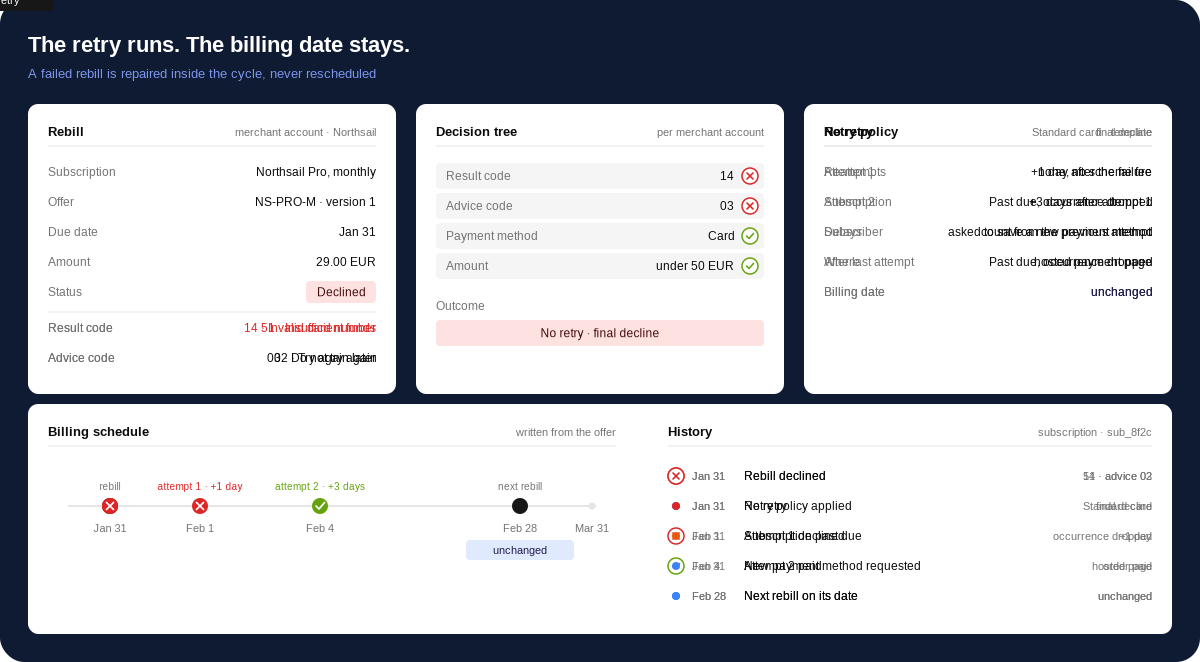
Each retry should be timed from the previous attempt, not from the original billing date, and the whole sequence should fit inside the billing cycle so that the next rebill runs on its own date whatever happened to the last one. The schedule is what the merchant and the subscriber agreed to; the retries happen inside it.
A policy with a first attempt at one day and a second at three days retries on day 1 and day 4 after the failure, not on day 3, because the second delay counts from the first retry. Delays in hours suit a transient issuer outage; delays in days suit insufficient funds, where the useful signal is the cardholder's next payday. Mastercard's "retry after" codes, from one hour to ten days, give a policy its outer bounds. Recovered volume comes from retrying the right codes at the right moment rather than from retrying often.
What the policy must never do is write a new billing date. If a rebill due on the 31st recovers on the 4th, the subscriber has paid for the same period and the next rebill still runs at the end of the month; revenue stays aligned with the service period, and reconciliation stays simple. Google Play, in its developer documentation, describes the same kind of recovery window: it will "periodically attempt to renew the subscription for some time before canceling", through a grace period where access continues and an account hold where it does not.
What happens to the subscription after the last retry fails?
A retry policy needs an explicit ending, and three are useful: keep billing, with the subscription back to active and the unpaid rebill flagged overdue; pause it until the merchant resumes it; or cancel it with payment failure recorded as the reason. Which one applies is a merchant decision, and the operator decides which merchants may choose it.
The first suits content and software subscriptions where one missed month is cheaper than a lost subscriber: the subscriber keeps the offer, the next rebill runs on its date, and the unpaid rebill stays on record, ready to be collected later through a hosted payment link. The second borrows from what consumers ask for: in the same Mastercard research, 34% said they would stay subscribed if they could pause instead of canceling, and a pause keeps the subscriber, the card and the history in place until the merchant resumes it, or reactivates the subscriber. The third is the honest one when the payment method is gone for good, and recording payment failure as the reason matters when the merchant wants the subscriber back: according to Antenna, 42% of the people who canceled a premium streaming service in 2024 came back within twelve months.
The market calls this process dunning, and many billing tools sell it as a sealed box: smart retries, intelligent recovery, rescue rates. An operator cannot explain a sealed box to a merchant who asks why a renewal was attempted four times, or never. A policy with named attempts, named delays and a named ending can be shown to that merchant in its own console, attempt by attempt.
How does a PSP, PayFac or ISV run retry policies for hundreds of merchants?
The operator publishes retry policies as templates, lets its program managers and merchants duplicate and adapt them within the rights it grants, and binds them to declines through a decision tree per merchant account, the Retry matrix. The tree reads the result code, the payment method, the scheme, the amount and other criteria, and, at the first failure of a rebill, ends on one of three paths: a policy set in the matrix, No retry, or the offer's own retry policy. With No retry, the rebill is flagged overdue at once and the subscription keeps its status. The chosen path then runs to its end.
A program manager running fifty software merchants can ship one policy for card rebills under 50 euros and another for annual offers; each merchant sees them under the operator's brand, in its own console, with a preview of the timeline before saving. When a merchant asks what happened to a renewal, the support team opens the subscription and follows the path the tree took: which criteria matched, which policy ran, which attempt failed or paid.
It also keeps two kinds of recovery apart. The platform's payment resilience layer recovers the one-off payments a merchant takes at checkout, with return-code mapping and retries on the same or another provider. Retry policies for subscriptions plan attempts around a schedule that must not move, on the acquiring connections the operator already runs. Both live in the same platform, next to routing and network tokenization, which is the point of running subscriptions inside it rather than beside it, as the first article in this series, on white-label subscription billing for payment operators, set out.
What else do operators ask about subscription retry policies?
How many times can a declined rebill be retried under Visa rules?
Visa allows up to 15 reattempts in a rolling 30 days for declines in the categories where a retry can succeed, and none for Category 1 codes, which mean the issuer will never approve. From the 16th attempt, a scheme fee applies, and acquirers pass it on to the accounts that triggered it.
What is a Mastercard Merchant Advice Code?
It is a code attached to a declined transaction that tells the merchant whether and when to try again. Code 03 means do not try again, code 21 signals a payment cancellation, and codes 24 to 30 set a minimum wait, from one hour to ten days, before the next attempt.
Does a successful retry change the next billing date?
It should not. A rebill due on the 31st and recovered on the 4th covers the same period, and the next rebill still runs at the end of the following month. Keeping the date fixed keeps revenue aligned with the service period and keeps reconciliation simple for every merchant.
What is the Retry matrix?
It is the decision tree, set per merchant account, that chooses which retry policy applies to a failed rebill. It reads the result code, the payment method, the scheme, the amount and other criteria, and ends on a policy set in the matrix, on No retry, or on the offer's own retry policy, so support teams can trace every attempt. The choice is made once, at the first failure of the rebill.
Which retry policy applies when no matrix rule matches?
The retry policy of the offer. Each offer carries its own policy, and the Retry matrix steps in first to override it for the declines that call for another plan.
Can a subscriber pay a failed rebill themselves?
Yes. The merchant sends a hosted payment link for the subscription. When the subscriber pays, the retries stop and the subscription returns to active.
Can an unpaid rebill be collected later?
Yes. Each unpaid rebill stays on record and can be paid through its own hosted payment link, whatever the status of the subscription. Only that rebill is paid: the calendar stays as it is and the overdue counter goes down by one.
A rebill that fails is a date to protect, not a date to move.
Retry policies are part of Subscriptions, a module of NORBr's white-label payment infrastructure that PSPs, PayFacs, ISOs and ISVs switch on per merchant account for the merchants who bill on a recurring basis.