
A PSP offers embedded payments to software platforms under its own brand by running a white-label payment platform with a partner layer: each software platform gets its own branded space, merchants and onboarding, while the PSP keeps the provider contracts, the risk and the overall view. NORBr provides that layer as white-label infrastructure, invisible to platforms and merchants.
Software companies now decide where a growing share of small merchants process their payments. A PSP that still signs merchants one by one meets them less often at the point of decision, and a PSP that hands its API to software platforms finds that each one wants its own brand, its own onboarding and a larger share of the margin. This article, published in November 2026, explains why software platforms became a distribution channel, what they expect from a PSP today, how PSPs usually serve them, where those models break when a PSP serves many platforms, and what a PSP needs to put in place, including what NORBr does and does not do.
Why are software platforms becoming a distribution channel for PSPs?
Because merchants increasingly get payments from the software they already run. Software providers offering integrated payments accounted for 36% of SME acquiring revenue in 2024, and BCG expects that share to reach 45% by 2028, according to its September 2025 report on embedded finance. The same report finds that more than half of the relevant independent software vendors in North America offered embedded payments in 2025.
For a PSP, that changes the sales motion. One agreement with a vertical software company for salons, clinics or logistics brings every merchant that software company signs, now and later. The PSP that is embedded in the software is the one the merchant uses by default.
What do software platforms expect from a PSP in 2026?
They expect to keep their brand on every screen and a growing share of the economics as they scale.
The economics are documented. The embedded payments playbook published by Worldpay and L.E.K. Consulting in 2026 estimates that a software platform processing $250 million to $1 billion a year keeps about 50% of the net payments margin under a referral model, 50% to 80% as a managed payment facilitator and 75% to 90% as a full payment facilitator. The further a platform moves along that path, the more of the payment experience it wants to control.
The brand follows the money. A platform that earns a share of every transaction wants its merchants to onboard inside its product, pay through a checkout in its colors and read their payouts in its back office. A PSP logo in the middle of that journey makes the platform look like a reseller of someone else's product.
How do PSPs serve software platforms today?
Three models cover most of the market, and each puts the line between PSP and platform in a different place.
In the referral model, the platform sends its merchants to the PSP. The merchant signs the PSP's agreement, onboards in the PSP's flow and sees the PSP's brand. The platform earns a referral fee and has little say over the experience.
In the API model, the PSP exposes its processing, onboarding and reporting through APIs and embeddable components, and the platform builds its own experience on top. The platform controls the front end. Each platform also builds its own onboarding screens, reporting views and support processes.
In the payment facilitator model, the platform becomes a payment facilitator sponsored by an acquirer. Visa's description of the payment facilitator model sets out the chain: the acquirer must register the payment facilitator with Visa, the payment facilitator contracts with each sponsored merchant and directs the settlement of their funds, and acquirers remain responsible for the acts of both. The path from referral partner to PayFac for SaaS platforms describes what each step demands of the software company.
Where do those models break when a PSP serves many software platforms?
They break on the PSP's side, at scale.
The referral model keeps the PSP in control and loses the platform. Once a software company outgrows a referral fee, it looks for a provider that lets it own the experience, and it takes its merchants along.
The API model keeps the platform and fragments the PSP. Twenty platforms build twenty onboarding flows, twenty reporting views and twenty ways of handling a chargeback. The PSP supports all of them and sees none of them as a whole: risk sits in twenty separate implementations, and a new payment method has to be adopted platform by platform.
The payment facilitator model moves responsibility to a party that is often not ready for it. A software company with hundreds of merchants and no payments team takes on registration, merchant monitoring and settlement. The exposure comes back to the PSP and its acquirer through the scheme rules anyway. Since April 2025, the Visa Acquirer Monitoring Program has counted fraud and chargebacks together, at portfolio and merchant level, so a weak platform shows up in the PSP's numbers.
What most PSPs need sits between the API model and the payment facilitator model: the platform owns the brand and the experience, the PSP owns the contracts, the risk and the view across every platform.
What should a PSP put in place to offer embedded payments under its own brand?
A partner layer that gives each software platform a white-label payment platform of its own, on infrastructure the PSP controls. In practice, that layer needs six things.
- A partner hierarchy. The PSP at the top, each software platform below it with its own merchants and users, and each merchant under one platform.
- Branding per platform. The platform's domain, theme and name on the merchant console, hosted pages and onboarding portal.
- Onboarding inside the platform's product. One merchant file that the PSP's risk team and each acquirer review, without the platform rebuilding the flow.
- Provider control per platform. The PSP decides which acquirers and local methods each platform may offer to its merchants.
- One API for every provider. With a sandbox, signed webhooks and stable versions, so each platform's product team builds once.
- Pricing per level. The PSP prices the platform, and the platform prices its merchants.
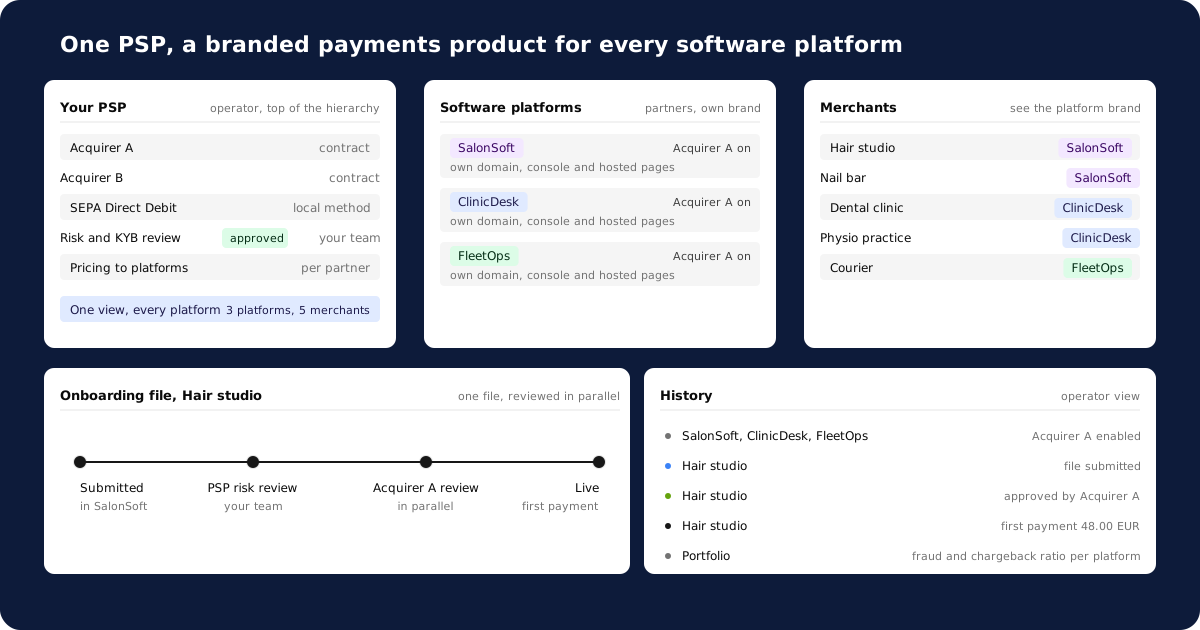
NORBr is built for that structure. The payment platform builder sets up the PSP's branded platform and the hierarchy below it: each software platform sits as a partner with its own brand, its own merchant portfolio and its own permissions, and the PSP chooses which providers cascade down to it. Merchant onboarding runs in the same platform, with one file per merchant that every partner reviews in parallel. Each merchant account signs its webhook deliveries with its own secret key, and a new program works in sandbox until production access is opened. The same mechanics let the platforms a PSP signs turn payments into a revenue line of their own, setting what their merchants pay. A PSP that starts from scratch can launch a new branded PSP on the same base.
NORBr is neither a payment gateway nor an acquirer. It does not hold funds, sign software platforms or underwrite their merchants, and it never sells to either: platforms see the PSP's brand, merchants see the platform's. The contracts with acquirers and the risk decisions stay with the PSP, along with the compliance duties that come with them. The criteria for choosing a white-label payment platform put multi-brand and reseller structures first for exactly this profile.
A software platform that sees its own brand on every screen has one less reason to look for another PSP.
What else do PSPs ask about embedded payments for software platforms?
Does each software platform need its own payment facilitator registration?
Not in a managed model. The PSP keeps the scheme registration and the acquirer relationship, and the software platform operates inside the PSP's program with its own brand and merchants. A platform that wants to become a payment facilitator itself needs a sponsoring acquirer to register it with the schemes, as Visa's payment facilitator model describes.
Can merchants see the PSP behind the software platform?
Under a white-label model, merchants see the software platform's brand on the console, hosted pages and onboarding portal. On NORBr, each partner level runs with its own brand, so the PSP stays in the background of the merchant relationship while it keeps the provider contracts and the view across every platform.
How do PSPs share payments revenue with software platforms?
Usually through a margin split that grows with the platform's volume and responsibility. Worldpay and L.E.K. Consulting estimate that a platform processing $250 million to $1 billion a year keeps about 50% of the net margin under referral and 50% to 80% as a managed payment facilitator. On NORBr, the platform sets what its merchants pay.
Can a software platform start small and take on more later?
It should be able to without moving its merchants. Ask whether a partner's permissions and branding can change while its merchant portfolio stays where it is. On NORBr, permissions are set per level of the hierarchy by the operator, so a platform's scope can be widened as it takes on more of the payment flow.