The transition from cash to digital payments is uneven: Japan and Germany move gradually, Brazil leapfrogged through Pix, and Mexico is catching up through instant transfers. For PSPs, PayFacs and ISVs serving merchants in these markets, the practical answer is a hybrid stack that supports local payment methods and instant rails, with routing and reconciliation handling the complexity.
Cash is declining everywhere, but at very different speeds, and each market's path shapes what merchants need from their payment provider. This article, updated in November 2026 with the latest central bank and government data, looks at the global picture, then at Japan, Germany, Brazil and Mexico, and at what operators should build for markets where cash and digital payments coexist.
How much cash is still used worldwide?
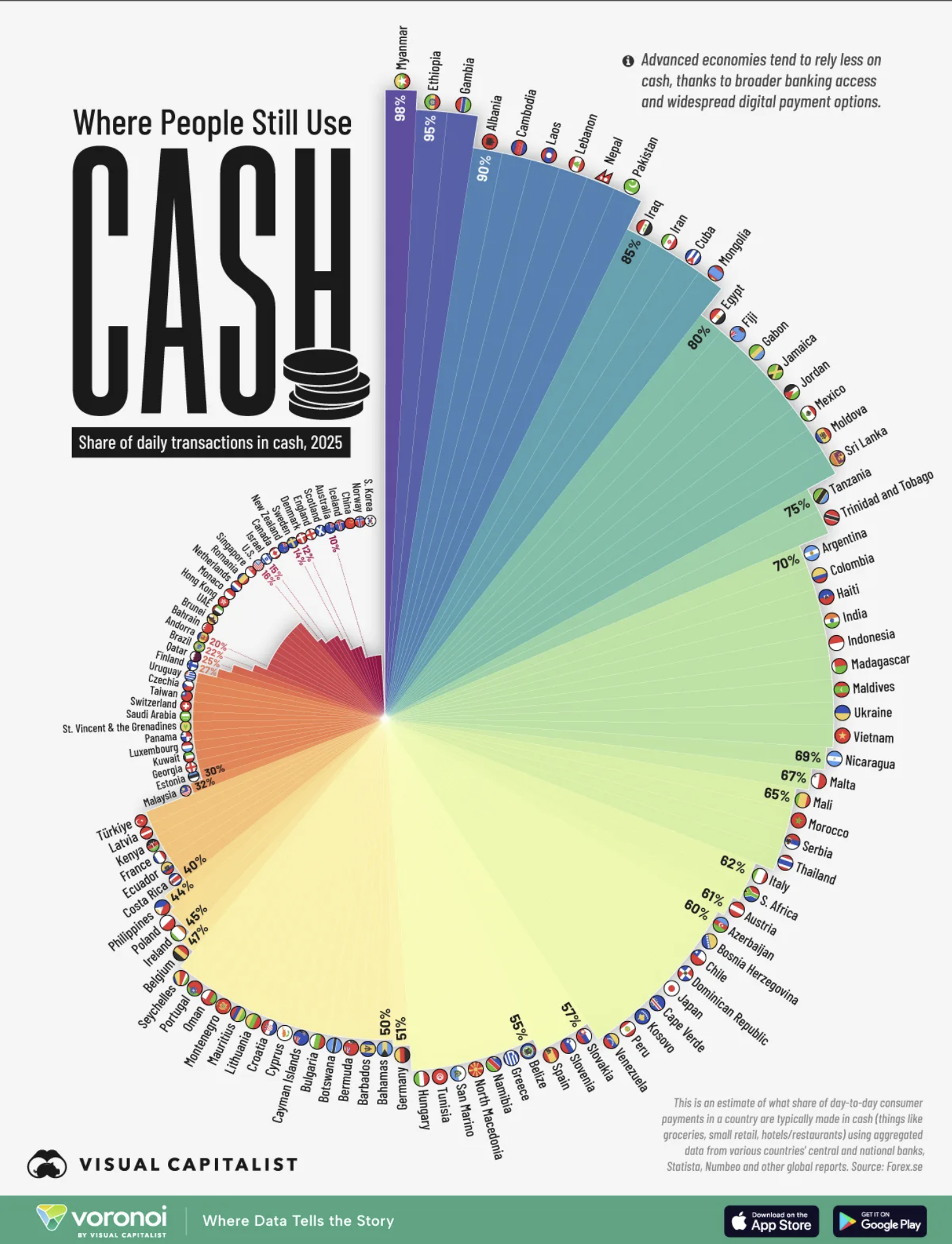
Still a lot, in some markets. Visual Capitalist's 2025 ranking shows countries where cash still covers the vast majority of daily transactions, up to about 98 percent in Myanmar. Even in digital-first economies, the Bank for International Settlements notes that demand for cash withdrawals has generally stabilized, a sign of the lasting role of cash.
For payment operators, the conclusion is the same everywhere: the shift is uneven by region, age group and channel, and the stack must support both new digital rails and merchants whose customers still pay in cash.
How far has Japan moved toward cashless payments?
Faster than expected. According to Japan's Ministry of Economy, Trade and Industry (March 2026), the cashless payment ratio reached 58.0 percent in 2025 on the domestic indicator, and the government now targets 65 percent by 2030 and 80 percent in the long term.
Cash persists among older consumers, small independent shops and vending machines. For a PayFac or PSP in Japan, the opportunities are digital onboarding of small merchants and acceptance of QR codes and mobile wallets such as PayPay alongside cards and JCB, with routing across methods.
Why does Germany keep a strong cash culture and what is changing?
Privacy concerns, habit and merchants' sensitivity to card fees long kept cash in first place. That has just changed: in the Bundesbank's payment behaviour study (June 2026), cash accounted for 45 percent of payments in 2025, six points less than in 2023, and cashless payments were used more often than cash for the first time.
For operators targeting Germany, the stack should cover girocard, international cards, Apple Pay and Google Pay, SEPA Instant transfers and Wero, presented as digital first with cash still accepted in store.
How did Pix make Brazil a blueprint for digital payments?
By making instant payments free for individuals, available 24/7 and accepted through QR codes at any merchant. Pix is now the most used payment method in the country: according to Banco Central do Brasil data reported in July 2026, it processed 36.3 billion transactions between January and May 2026, 26 percent more than a year earlier.
Cash remains for informal and low-connectivity segments, and card acceptance still matters for credit and installments. For operators serving Brazil, Pix must sit next to cards and Elo, with recurring Pix and refunds handled at platform level. The A2A payments article places Pix among other real-time systems.
What slows digital payments in Mexico and how do operators adapt?
A large unbanked population, informal commerce and limited merchant equipment in rural areas. Cash still represents roughly 62 percent of transactions, according to Mexico Business News (January 2026), citing Banxico data, while the SPEI instant transfer system already counts more than 73 million adult users.
For ISVs and PSPs in Mexico, the path runs through low-cost acceptance, transfers and cash vouchers for online purchases, and cards including the domestic Carnet scheme, covered in the card networks article.
How do EU instant payment rules change the picture in cash-heavy European markets?
They make instant transfers a standard feature of every euro account. Under the EU Instant Payments Regulation, as summarized by the European Central Bank, payment service providers in the euro area had to be able to receive instant euro payments from January 9, 2025 and to send them from October 9, 2025, at a price no higher than a standard transfer, with verification of payee offered from the same date.
In a market such as Germany, where cash still accounts for a large share of payments, instant transfers give consumers a digital option that settles like cash: immediately and without a card. They are also the rail behind new account-based methods such as Wero, which the European Payments Initiative launched for e-commerce in Germany in late 2025.
For operators, instant rails change reconciliation more than checkout. Payments arrive in seconds, refunds are new transfers, and every credit has to be matched to an order. Reconciliation and settlement that treats instant transfers like any other method, and payment rails combined behind one integration, keep that work at platform level.
What should PSPs and PayFacs build to serve hybrid cash-and-digital markets?
A stack that follows each market's pace rather than forcing one model:
- Local method coverage: cards and domestic schemes, wallets, instant transfers and voucher methods, activated per market from the global payment network.
- Routing and fallback across methods and providers, with routing rules per country.
- Reconciliation that brings card, instant and voucher payments into one view.
- Data to follow adoption, costs and approval rates as each market shifts.
In store, card and wallet payments made on terminals have to be matched with online activity, which Matcher™ handles for operators running both channels. For operators expanding into new markets, that is the difference between launching country by country and redesigning the stack each time. Cash declines at each market's own pace, and the stack has to keep up with the fastest of them.
What else do operators ask about the cash-to-digital transition?
Will cash disappear in the markets covered here?
Not soon. Japan, Germany, Brazil and Mexico all show cash declining, but at very different speeds, and central banks continue to issue and support it. For payment operators, the realistic plan is a mix in which digital methods grow while in-store merchants keep accepting cash.
Which payment methods should an operator add first in a cash-heavy market?
The ones customers already use instead of cash. That is often an instant transfer system with QR codes, such as Pix in Brazil or SPEI in Mexico, alongside domestic card schemes and the leading mobile wallets. Local data from central banks and the #PayWorldTour guides help set the order.
Do instant payments replace cards for merchants?
No. Instant payments add a lower-cost option with immediate settlement, while cards remain essential for credit, installments, recurring payments and cross-border sales. Operators offer both and use routing rules to present the right method per market, merchant and transaction type.