
A cardholder taps "Item missing" in a banking app at 10:05. Two minutes later, a pre-chargeback alert lands on the transaction it refers to, the refund is issued, and the claim is closed before it ever becomes a chargeback. For the merchant, nothing happened. For the platform that processes its payments, everything happened in the right order.
That order depends on one step most teams never see: matching. An alert from Visa or Mastercard does not arrive with your transaction ID attached. It arrives with a card, an amount, a date and a few network references. Before anyone can refund, someone, or something, has to find the payment it is about. On NORBr, that match happens automatically, where the payment was processed, so each alert lands on its transaction with the full payment journey behind it.
Here is how pre-chargeback alerts work, why matching decides whether they pay off, and what PayFacs, PSPs, ISOs and ISVs give their merchants when the match is automatic.
What is a pre-chargeback alert?
A pre-chargeback alert is a notification sent by a card network service when a cardholder disputes a payment with the issuing bank, before that dispute becomes a chargeback. It opens a short window in which the merchant can refund the customer and close the claim. Every chargeback starts as a claim. Between the two sits a window to refund.
Three services carry most of these alerts. Visa's Verifi runs Rapid Dispute Resolution (RDR), which resolves Visa disputes automatically with a customizable decision engine, and the Cardholder Dispute Resolution Network (CDRN), which gives merchants 72 hours to issue a credit before a chargeback is filed. Mastercard's Ethoca sends alerts that let a merchant stop fulfillment or process a refund, eliminating the need for a chargeback.
Why does a refund now cost less than a chargeback later?
A refund returns the amount. A chargeback returns the amount, adds a fee, consumes the merchant's time on evidence it usually does not win, and counts against monitoring thresholds that put the whole portfolio at risk.
The thresholds are what turn a merchant problem into a platform problem. Visa's acquirer monitoring program rates a merchant Excessive at a 1.5% ratio of fraud and disputes from April 2026 in Europe, the US, Canada and Asia Pacific. Mastercard flags an Excessive Chargeback Merchant at a 1.5% chargeback rate and more than 100 chargebacks a month. And disputes resolved before they become chargebacks are excluded from the VAMP ratio. A pre-chargeback alert answered in time is one dispute less in the ratio your acquirer is watching.
What is the difference between RDR and CDRN or Ethoca alerts?
One refunds itself. The other waits for you.
With RDR, the merchant sets its rules once: which disputes to accept, by amount, reason or card range. When a Visa claim matches a rule, the refund is applied automatically by the network, without anyone at the merchant opening a screen. The claim is closed before it reaches chargeback status.
With CDRN and Ethoca, the alert is sent to the merchant's team, who decides whether to refund within the window. The decision stays human: a merchant may want to check whether the item shipped, whether the subscription was cancelled, or whether the claim looks like first-party misuse before giving the money back.
Both paths end the same way, with a refund and no chargeback. Both depend on the same thing first: knowing which transaction the alert is about.
Why is matching an alert to its transaction the hard part?
Because the alert and the transaction come from two different worlds. The alert is built from the issuer's record of the payment. The transaction lives in the processing system that captured it. They share data, but not an identifier you can join on.
Mastercard's own transaction matching guidance for Ethoca shows how much work this takes. It recommends a cascade of conditions, from the acquirer reference number and date, to the authorization code with the exact amount, to the card's first six and last four digits with a fuzzy amount, accepting a date gap of two days and an amount variance of 5% after currency conversion, and returning a transaction only when exactly one matches. It also warns that merchants who hold tokenized card numbers should not filter on the card first.
A merchant that receives alerts by email, or through a dispute tool disconnected from its payments, runs that logic by hand: search the back office by amount, then by date, then by card, then hope there is only one result. On a busy day, the window closes before the search does.
How does automatic matching work on NORBr?
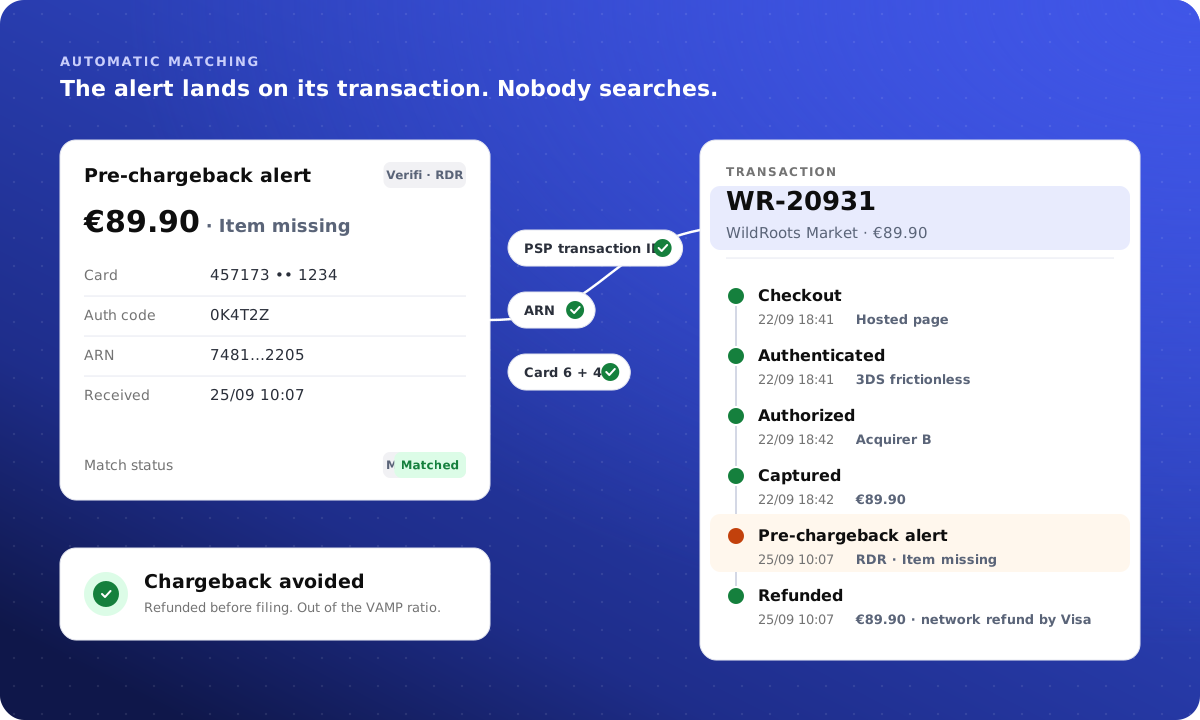
NORBr runs the matching where the payment was processed. When an alert arrives from Verifi or Ethoca, NORBr Pre-chargeback Alerts looks for the transaction using the PSP transaction ID, the acquirer reference number or the card data, and links the alert to it. No export, no lookup in another tool, no copy and paste between screens.
Once matched, the alert becomes an event in the transaction's history. Open payment WR-20931 for €89.90 and the timeline reads: checkout on the hosted page, authenticated with 3-D Secure frictionless, authorized by the acquirer, captured, pre-chargeback alert from RDR for "Item missing", refunded automatically, all with their timestamps. Whoever opens the payment next, a support agent or a risk analyst, sees why the money went back without asking anyone.
The match also makes the refund status readable in both directions. From the alerts table, each alert shows whether it was matched, whether it was refunded, and the reason for the refund. From the transactions table, each payment shows whether it was refunded and why. An RDR alert shows the refund as a network refund by Visa, because the network issued it.
What do your merchants see, and under whose brand?
Your merchants see their alerts where they already work, under your brand. Each alert arrives on its transaction, ready to refund, with its source shown as Verifi or Ethoca and NORBr nowhere on the screen.
The same holds down the chain. A platform such as Mirevault Holdings can serve a client like Dralune Commerce, which serves its own merchants such as RetailO. Each program runs its own alerts: Dralune's team handles the alerts of its three merchants, RetailO sees only its own, and the refund on WildRoots Market's €89.90 order shows up for each of them at the level they are allowed to see. Alerts are enabled merchant account by merchant account, so you decide which merchants get the service and when.
Underneath, it is one infrastructure: the alert, the match, the refund and the transaction live in the same place, so nothing has to be reconciled after the fact.
What should an operator check before offering pre-chargeback alerts?
Three questions decide whether the service protects your portfolio or adds another inbox. First, where does matching happen? If it happens outside the system that processed the payment, expect a share of alerts to arrive with no transaction attached. Second, where do alerts land? If merchants receive them in a separate tool, the refund will be issued from somewhere else and the payment record will not say why. Third, whose brand is on it? If your merchants log into a third party's portal to handle their alerts, the service is not yours to sell.
The cardholder who tapped "Item missing" never learns any of this. They get their €89.90 back the same morning, and the merchant keeps a clean ratio.
NORBr Pre-chargeback Alerts gives PayFacs, PSPs, ISOs and ISVs Verifi and Ethoca alerts matched to their transactions automatically, under their own brand. Talk to us about resolving your merchants' claims before they become chargebacks.