Recover failed rebills. Keep the schedule.
Every failed payment gets the retry that fits its reason.
When a rebill is declined, a retry policy plans the next attempts, down to the minute. The Retry Matrix picks that policy from the result code, the payment method and more, and the following rebills keep their dates.
Book a demo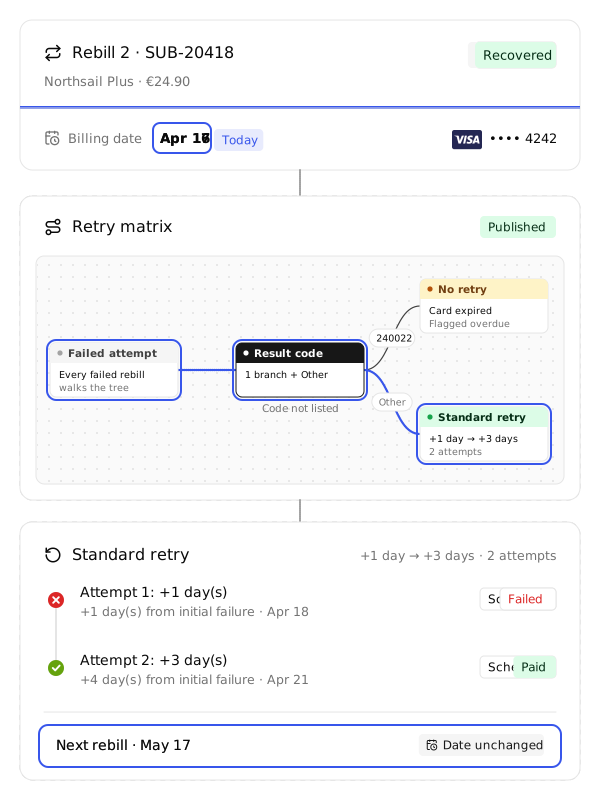
Retry policies,
chosen by the Retry Matrix.
A retry policy plans the attempts after a failed rebill. The Retry Matrix decides which policy applies, reason by reason. Together they recover failed subscription payments for your merchants without ever moving the billing schedule.

A missed payment never derails the schedule.
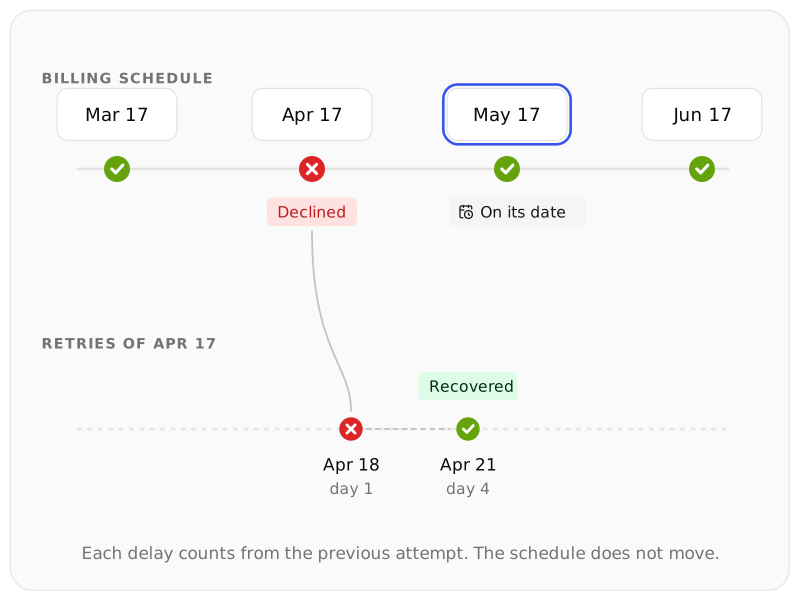
Retries are counted from the previous attempt, never from the billing date. The billing schedule runs on one track, the retries of a failed rebill on another. A rebill recovered on day 4 does not move the next one: it stays on its own date, whatever happened to the one before.

Retry in minutes, hours, days or weeks.
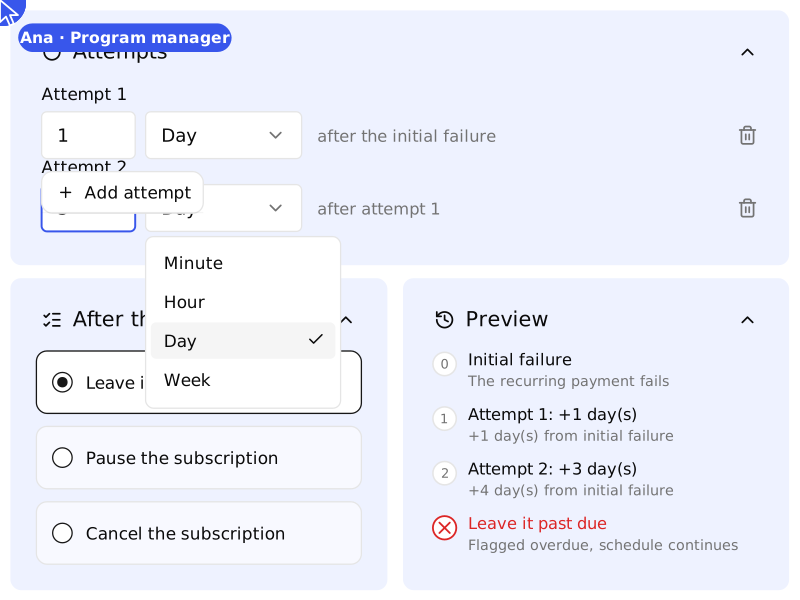
A retry policy is a list of attempts, each with its own delay: plus 59 minutes, plus 36 hours, plus 3 weeks. Each delay counts from the previous attempt, not from the initial failure. A preview shows the resulting timeline before anything is saved: initial failure, each attempt, then what happens after the last one.

The right retry for every reason.
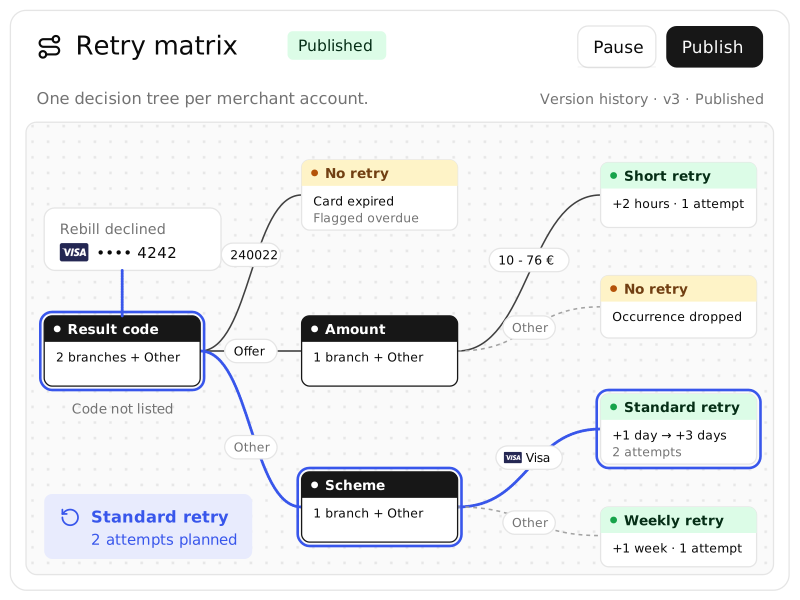
The Retry Matrix is a decision tree, one per merchant account. A failed attempt walks it on the result code, the payment method and type, the scheme, the issuer and its country, the BIN, the amount, the offer or one of your lists. The first matching branch wins, Other catches the rest, and every path ends on a retry policy or on No retry. Edit the tree, publish it, and find every version in its history.
After the last attempt.
Each retry policy decides what happens when its last attempt fails. A path of the matrix can also end on No retry: the occurrence is dropped at once and the issuer is not asked again.
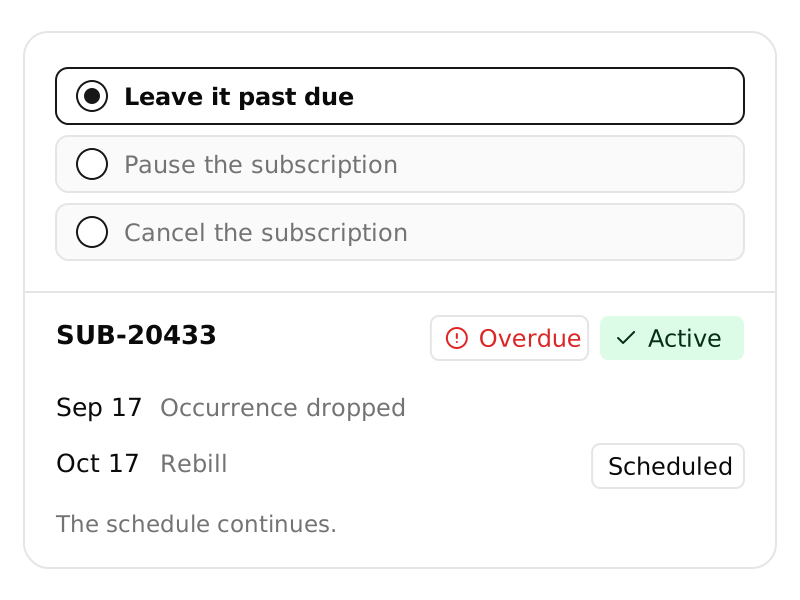
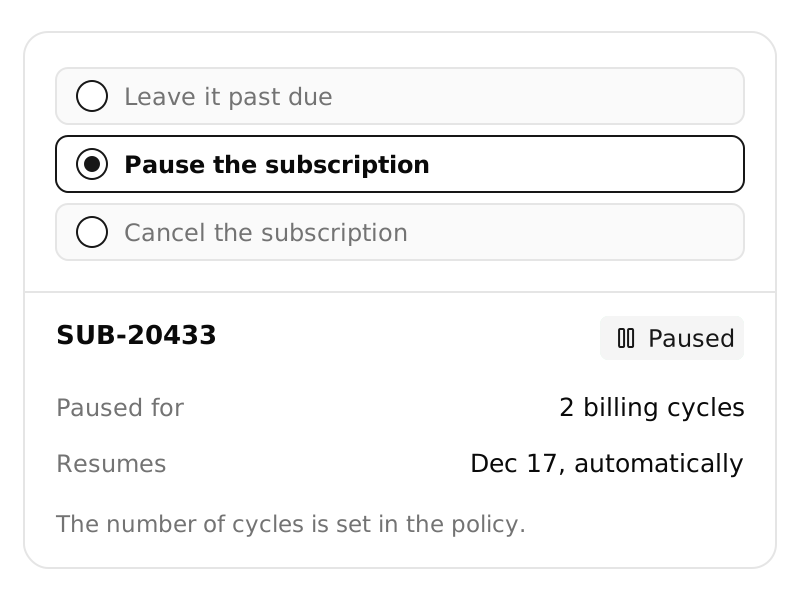
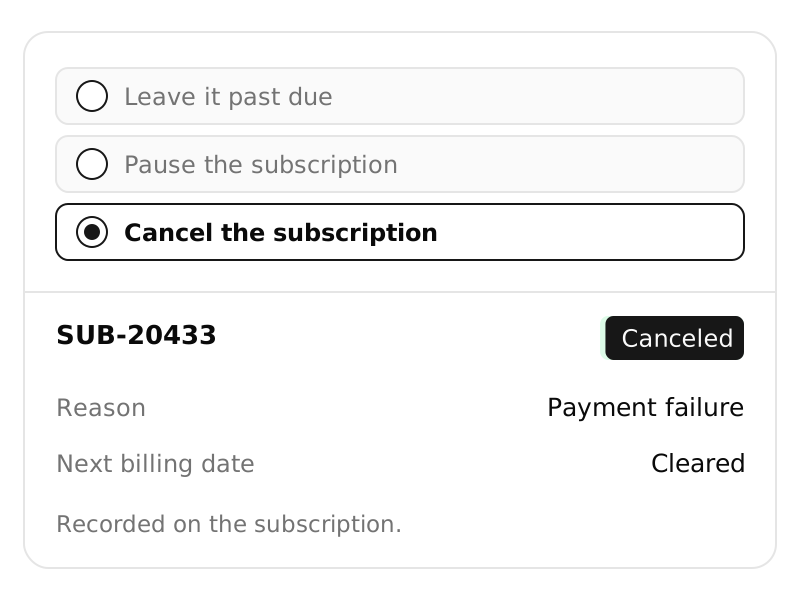
Leave it past due
The default. The missed occurrence is dropped, the schedule continues and the subscription is flagged overdue.
Pause the subscription
The subscription pauses for the number of cycles the policy sets, then resumes on its own.
Cancel the subscription
The subscription is canceled, with payment failure recorded as the reason.
Retry templates,
from your program.
Your teams share what works. Program managers write retry policies once, and the merchants on your platform start from them instead of a blank page.

Suggested, then duplicated.
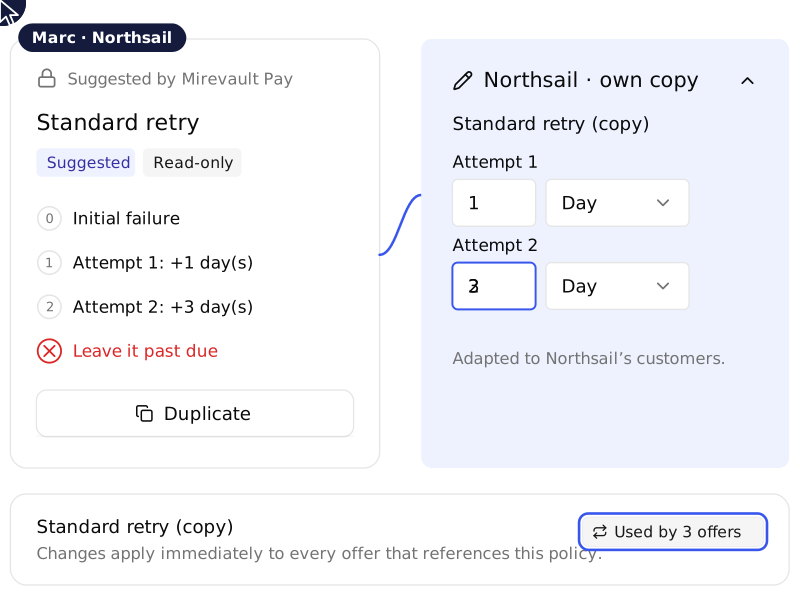
Your program managers suggest retry policies. Companies see them read-only, duplicate the ones that fit and adapt them. Each policy shows how many offers use it, every offer names the policy consulted on failed attempts, and a change to a policy applies at once to every offer that uses it.
Built for rebills.
Retry Policies & Matrix covers the recurring charges of Subscriptions: retries planned around a schedule that must not move, and chosen by the matrix. The payments your merchants take one at a time follow the recovery logic described in Payment Resilience. Both run on the same platform, under your brand.