Payment fallback routing automatically resends a declined or failed transaction to an alternative acquirer or PSP instead of returning the error to the shopper. For PayFacs, PSPs, ISOs and ISVs running a white-label payment infrastructure, it means their merchants recover otherwise lost sales without any manual retry, under the operator's own brand.
Even with good routing, some payments fail for reasons that have nothing to do with the customer. This article, updated in November 2026, explains what payment fallback routing is, why transactions fail after a correct first route, how a fallback engine decides what to do with each failure, how fallback differs from retries and smart routing, what it changes for merchants, and how operators can offer it under their brand.
What is payment fallback routing?
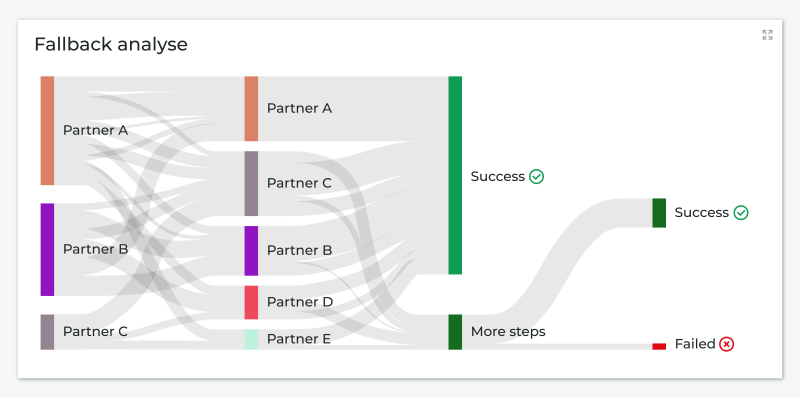
Fallback routing is a rule that says what happens when a payment attempt fails: try again on the same provider, send the payment to another provider, or stop and return the decline. It runs within the same checkout session, so the customer simply sees the payment succeed, or fail only once all reasonable options are exhausted.
It requires at least two providers able to process the same payment and a way to reuse the payment credentials with both, which is why fallback depends on universal or network tokens. The tokenization article explains that link.
Why do transactions fail after a correct initial routing?
Because many failures come from the route, not the card. A provider may be unavailable or slow, an acquirer may reject a transaction for technical or configuration reasons, a currency or card type may not be supported on that contract, or an issuer may respond differently to a domestic and a cross-border acquirer.
Others come from the cardholder or the issuer: insufficient funds, a stolen card, a suspected fraud or a closed account. Telling these two families apart is what makes fallback useful rather than risky. The payment routing article covers how the first route is chosen.
How does a fallback engine decide where to reroute a failed transaction?
From the return code. Each provider's decline and error codes are mapped to a normalized set, and each code is tied to an action: retry on the same provider for transient issues, reroute to another provider for structural ones, or do nothing when retrying is pointless or forbidden.
On NORBr, that mapping is an editable table in the payment resilience settings. Codes governed by scheme rules are pre-configured and locked, others can be customized per merchant, and the operator sees every merchant's fallback configuration and recovery rate in one place.
What is the difference between fallback, retry and smart routing?
- Routing chooses the first provider for a payment, based on rules such as country, card type, amount or channel.
- Fallback sends a failed payment to a different provider, in the same session.
- Retry tries again, on the same or another provider, immediately for transient errors or later for recurring payments, within scheme limits on repeated attempts.
Hard declines, such as a lost or stolen card, should never be retried: card schemes charge fees for excessive reattempts, as described in the payment processing fees guide.
How do card scheme retry rules limit fallback and retries?
They cap how often the same card can be tried, whatever the provider. According to PayPal's guide to scheme retry rules, Visa allows up to 15 retries over a rolling 30 days for temporary declines such as insufficient funds, and none for declines such as an invalid account, with fees for every attempt beyond the limit. Payway's summary of Visa's Excessive Reattempts rule gives the same limits and lists the codes that must never be retried, including lost and stolen cards.
Mastercard applies its own thresholds. Its Transaction Processing Excellence program charges for excessive authorization attempts on the same card, typically after ten attempts in 24 hours, with regional variations, as IXOPAY explains.
Two consequences follow for a fallback engine. Attempts must be counted per card across all providers, since the scheme sees one card, not several acquirers. And recurring payments need retry policies spread over days rather than repeated attempts in one session, which is how subscription retry policies schedule failed renewals. Recovery and retry rates per merchant, visible in analytics dashboards, show whether the rules stay within those limits.
What does fallback routing change for a PSP's or PayFac's merchants?
Fewer lost sales from failures that were never the customer's fault, without any action from the merchant or the customer. Outages at one provider stop being outages for the merchant, and the merchant does not need its own development team to handle multi-provider retries.
For the operator, recovered transactions are recovered revenue on its own margin, and fallback becomes a feature it can show in its offer, with recovery rates visible per merchant.
How can an operator offer fallback routing under its own brand?
By running merchants on infrastructure where fallback is part of the platform, not a custom project. On NORBr, operators connect several acquirers and PSPs from the global payment network, merchants set their routing and fallback rules from a console under the operator's brand, and return code mappings and SCA rules are configured without code.
The payment revenue page shows how recovered volume turns into revenue for the operator. The best fallback is the one the shopper never notices, and the one the card schemes never have to count.
What else do operators ask about payment fallback?
Does fallback trigger a second 3-D Secure authentication?
Not necessarily. When the payment moves to another provider in the same session, the authentication result can often be reused if the second provider supports it, so the shopper is not challenged twice. Where it cannot be reused, the fallback rule should weigh the cost of a second challenge against the chance of approval.
Which declines should never be sent to another provider?
Declines that say the card or account cannot be used, such as lost, stolen or closed accounts, invalid card numbers and suspected fraud. Sending them elsewhere does not change the issuer's answer and counts toward scheme retry limits and fees.
Is fallback useful with only one acquirer?
Partly. With a single acquirer, retries can handle transient technical errors, but rerouting needs at least two providers able to process the same payment. Most operators add a second provider for exactly that reason, often one with local acquiring in their largest market.