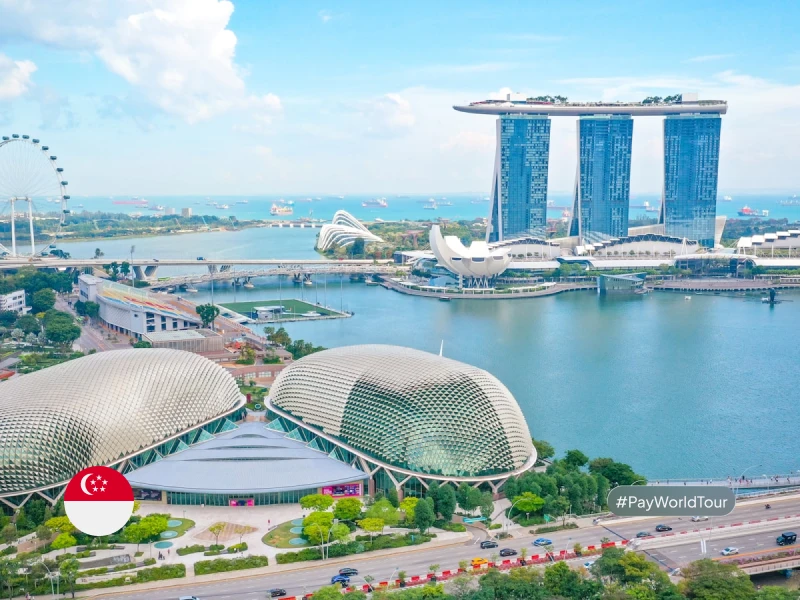

How people pay in Singapore in 2026
Singapore is a cash-lite, card-rich market with one of the strongest account-to-account schemes in Asia. PayNow, the instant payment overlay run by the banks on the FAST rails, had around 11 million proxy registrations and carried S$154 billion of consumer payments and S$147 billion of business payments in 2025, according to the PayNow Generation 2 report published by MAS and the Association of Banks in Singapore in June 2026. The same report puts digital wallets and account-to-account payments at about 48% of retail consumer-to-business value. Cards still lead online and in many stores: UOB’s 2025 ASEAN Consumer Sentiment Study found that 52% of Singaporeans use physical credit cards, the highest rate in the region.
At the counter, NETS, the domestic debit and QR network owned by the three largest local banks, sits next to Visa, Mastercard, Apple Pay and Google Pay. Merchants display a single SGQR or SGQR+ code that accepts PayNow, NETS QR, GrabPay, ShopeePay and bank wallets. Cash keeps a place at hawker centers and with older shoppers, and BNPL is led by Atome, which Grab agreed to buy in September 2026. For PSPs, a Singapore checkout without PayNow and local wallets leaves money on the table.
- S$301 billion paid through PayNow by consumers and businesses in 2025 (MAS and ABS)
- 11 million PayNow proxy registrations at the end of 2025 (MAS and ABS)
- 6.15 million principal credit and charge cards in Q2 2026 (MAS via SingStat)
- 63% of Singaporeans still use cash in regular transactions in 2025 (UOB)
Payment by card in Singapore
Card ownership is close to universal in Singapore. MAS data published by SingStat counts 6.15 million principal credit and charge cards and 0.86 million supplementary cards in the second quarter of 2026, for a resident population of about 6 million. MAS retail payment statistics quoted by PwC Singapore and the Singapore FinTech Association show S$99.39 billion of credit card payments and S$49.52 billion of debit card payments in 2024. Visa, Mastercard and American Express dominate credit, while NETS runs the domestic debit network on bank ATM cards.
Online, cards remain the default. A 2026 IDC study for 2C2P, cited in 2C2P’s Singapore payment guide, estimates that cards account for 73% of e-commerce transactions. Bank installment plans on DBS, OCBC, UOB and Amex cards are common for larger purchases. The cost of acceptance is the weak point: the PayNow Generation 2 report puts international card acceptance at 250 to 300 basis points, against 25 to 80 for PayNow, so merchants watch interchange fees closely and steer local shoppers toward QR.
Card schemes in Singapore
Visa

International scheme
The most widely carried brand on Singapore credit and debit cards, accepted at almost every terminal and online checkout, and used for contactless transit fares.
Mastercard

International scheme
The second international scheme, issued by all major local banks and digital banks on credit, debit and prepaid cards.
American Express

International scheme
Issued directly and through local banks, Amex is accepted by most large retailers and e-commerce sites, and Shopee lists it alongside Visa and Mastercard.
NETS

Domestic debit scheme
Singapore’s domestic electronic payment network, owned by the three largest local banks, used for PIN and contactless debit payments with bank ATM cards at retail and food outlets.
150,000+ NETS acceptance points in Singapore, NETS
Credit card installment plans
Card installments
Bank installment payment plans let cardholders of DBS/POSB, OCBC, UOB and Amex split larger online purchases, as offered at checkout by Shopee Singapore.
Payment by cash in Singapore
Singapore has moved far from cash, but it has not dropped it. In UOB’s 2025 ASEAN Consumer Sentiment Study, 63% of Singaporeans said they still use cash in their regular transactions, and 51% prefer cash when traveling abroad, the highest share in ASEAN. MAS retail payment statistics, quoted by PwC Singapore, recorded S$55.14 billion of ATM cash withdrawals in 2024, more than half the value of credit card payments.
Cash matters most at hawker centers, wet markets and small neighborhood shops, although many hawkers now also display an SGQR code. Online, cash is marginal: the 2026 IDC study for 2C2P quoted in 2C2P’s Singapore guide gives cash and other minor methods about 2% of e-commerce transactions, and Shopee Singapore no longer lists cash on delivery among its payment options. The government strategy is a gradual shift from cash to digital payments, not a ban, and stored-value cards such as NETS FlashPay remain a cash-like option for small payments and transit.
Cash payment methods in Singapore
Cash
Banknotes and coins
Singapore dollar notes and coins remain common at hawker stalls, markets and small shops, and are widely available through bank ATM networks.
63% of Singaporeans use cash in regular transactions in 2025, UOB ASEAN Consumer Sentiment Study
NETS FlashPay
Stored-value card
A contactless prepaid card introduced in 2009 for food courts, convenience stores, supermarkets and public transport. The transport ministry confirmed that card-based fare cards stay usable until at least 2030.
Payment by bank transfer in Singapore
Account-to-account payments are where Singapore stands out. PayNow lets people and companies send money with a mobile number, NRIC/FIN or business UEN, on top of the FAST instant payment system. According to the MAS and ABS PayNow Generation 2 report, more than 90% of adults and about 350,000 business entities were registered at the end of 2025, and PayNow values grew from S$132 billion to S$154 billion for consumers and from S$109 billion to S$147 billion for businesses between 2024 and 2025. PayNow transfers are capped at S$200,000, and cross-border links with India, Malaysia and Thailand carried S$371 million in 2025.
MAS and ABS now plan a PayNow and NETS QR interoperability pilot by end-2026 and deep-linked PayNow checkout within a year, both of which matter for e-commerce. GIRO, introduced in 1984, still handles direct debits for bills, taxes and subscriptions, while corporate checks are on the way out: banks stopped issuing new corporate checkbooks at the end of 2025 and will stop processing corporate cheques at the end of 2026. Our guide to account-to-account payments explains why these rails matter.
Bank transfer methods in Singapore
PayNow

Instant payment overlay
The bank-run proxy payment service built on FAST, used for person-to-person transfers and for QR payments at merchants, and offered online by most local gateways. It is free for consumers.
S$154 billion of consumer PayNow payments in 2025, MAS and ABS
PayNow Corporate
Business A2A payment
The business version of PayNow, linked to a company’s Unique Entity Number, used by merchants to receive QR payments and by companies for B2B payments and payouts.
S$147 billion of business PayNow payments in 2025, MAS and ABS
FAST
Instant payment
Fast And Secure Transfers, the interbank real-time system in Singapore dollars that underpins PayNow and lets bank customers move funds almost instantly.
S$200,000 current transaction limit for PayNow-FAST transfers, MAS and ABS
GIRO and eGIRO
Direct debit
Singapore’s interbank direct debit and credit system, introduced in 1984 and used for utilities, taxes, insurance and recurring payments; eGIRO lets customers set up mandates online, for example to top up ShopeePay.
eNETS
Online bank debit
NETS’ online payment service, which lets consumers pay on merchant websites and apps by direct debit from their bank account or by card.
PayNow cross-border links
Cross-border A2A
Linkages between PayNow and India’s UPI, Malaysia’s DuitNow and Thailand’s PromptPay let users send money with a mobile number, and QR links let visitors pay with their home apps.
S$371 million sent across live PayNow cross-border links in 2025, MAS and ABS
Payment by installment and BNPL in Singapore
Buy now, pay later is a niche but established checkout option in Singapore. The 2026 IDC study for 2C2P quoted in 2C2P’s Singapore guide estimates BNPL at about 5% of e-commerce transactions, and 29% of enterprise merchants surveyed offer it. The market leader is Atome, a Singapore-based lender that grew 2025 revenue by 80% to US$470 million and gross merchandise volume by more than 60% to over US$4 billion across Southeast Asia.
The market is consolidating around super apps. On September 15, 2026, Grab agreed to buy 60% of Atome Financial for US$1.49 billion, with the rest to follow about two years after completion, expected by the third quarter of 2027. Shopee runs its own SPayLater, ShopBack absorbed hoolah into ShopBack PayLater in 2022, and Grab offers PayLater inside the Grab app. Bank card installment plans remain the main alternative for large tickets. Gateways such as HitPay bundle Atome, ShopBack PayLater and SPayLater in one integration.
Installment and BNPL providers in Singapore
Atome

BNPL
Singapore’s leading BNPL brand, offering split payments in three installments online and in stores, and part of Atome Financial, which Grab agreed to acquire in 2026.
25 million cumulative transacted users and 30,000+ brands across its markets in 2026, Grab
ShopBack PayLater

BNPL
The cashback platform’s pay-in-three option, built on the hoolah platform ShopBack acquired, and still offered by local gateways such as HitPay.
SPayLater

Marketplace BNPL
Shopee’s deferred payment option, provided by Monee (Credit) Singapore, available on Shopee and, since July 2025, for subscriptions at HitPay merchants.
GrabPay PayLater

Super app BNPL
Grab’s pay-later balance, usable for rides, food delivery and partner merchants, and accepted online and by QR through gateways.
Credit card installment plans
Bank installments
Interest-free installment plans from DBS/POSB, OCBC, UOB and Amex, widely used for electronics and travel, and offered at checkout by large marketplaces.
Payment by digital wallet and X-Pay in Singapore
Wallets in Singapore come in two families. The first is X-Pay: Apple Pay, Google Pay and Samsung Pay tokenize local cards for tap-to-pay, and they work on public transport too. In December 2023, the transport ministry said 41% of adult commuters paid fares with bank cards or mobile wallets. The second is QR wallets. Bank apps such as DBS PayLah! and super apps such as GrabPay and ShopeePay pay at any SGQR code. Fintech News data quoted by 2C2P ranks DBS PayLah! first for online shopping in 2025 with 26%, ahead of GrabPay at 17% and ShopeePay at 4%.
Wallet use is lower than elsewhere in ASEAN: UOB measured 43% e-wallet usage in 2025, against 56% for PayNow scan-to-pay in banking apps. Acceptance is unified. SGQR+, run by NETS, lets a merchant accept 18 payment schemes and issuers through one acquirer. Read how QR code payments changed Asian checkouts.
Digital wallets and X-Pay in Singapore
Apple Pay

Mobile wallet
Apple’s wallet, used for contactless payments in stores and on transit with tokenized Visa, Mastercard and Amex cards, and offered at checkout by major marketplaces.
41% of adult commuters paid fares with bank cards or mobile wallets in December 2023, Ministry of Transport
Google Pay

Mobile wallet
The Android wallet for tap-to-pay and in-app payments with tokenized cards, listed by Shopee Singapore for Android users.
DBS PayLah!

Bank wallet
DBS’s mobile wallet, open to customers of any bank, used for PayNow transfers, SGQR payments and express checkout online.
26% of online shoppers named it their main wallet in 2025, Fintech News via 2C2P
GrabPay
Super app wallet
Grab’s wallet, used for rides and food delivery and for QR and online payments at partner merchants, with rewards linked to the Grab ecosystem.
17% of online shoppers named it their main wallet in 2025, Fintech News via 2C2P
ShopeePay

Marketplace wallet
Shopee’s wallet, topped up by card, PayNow or eGIRO, used on Shopee and at SGQR merchants, and available for subscriptions through gateways.
SGQR+ and NETS QR
QR acceptance
SGQR+ is the interoperable version of the national SGQR label, run by NETS, which lets merchants take payments from many wallets and bank apps through a single acquirer.
24,000 SGQR+ acceptance points at islandwide rollout in November 2024, NETS
Payments in Singapore: FAQ
What is the most popular payment method in Singapore?
It depends on the channel. Cards lead e-commerce, with an estimated 73% of online transactions in 2026 according to an IDC study quoted by 2C2P. In person and between people, PayNow dominates, with S$301 billion of consumer and business payments in 2025.
Do people in Singapore still use cash?
Yes, though less each year. In UOB’s 2025 survey, 63% of Singaporeans said they still use cash in regular transactions, mainly at hawker centers and small shops. Online, cash and other minor methods weigh only about 2% of transactions.
Which BNPL providers operate in Singapore?
Atome leads, alongside ShopBack PayLater, Shopee’s SPayLater, GrabPay PayLater and bank card installment plans. Grab agreed in September 2026 to buy 60% of Atome Financial for US$1.49 billion, with completion expected by the third quarter of 2027.
Can foreign visitors pay with their home QR apps in Singapore?
In some cases. PayNow is linked with India’s UPI, Malaysia’s DuitNow and Thailand’s PromptPay, and these links carried S$371 million in 2025. MAS and ABS list more cross-border connections among the PayNow Generation 2 priorities.
Accept local payments in Singapore with NORBr
In Singapore, MAS-licensed gateways bundle cards, PayNow QR, GrabPay, ShopeePay and BNPL, while NETS and the large banks acquire in stores. Check for a Major Payment Institution license, dynamic PayNow QR with automatic reconciliation, and PayNow and NETS QR interoperability.
With NORBr, you can connect any acquirer, PSP or local provider that offers PayNow, NETS, cards, wallets such as DBS PayLah! and GrabPay, and BNPL such as Atome. Some are already in our connector catalog; Mapper™ gets the others live in days, and Smart Checkout shows each shopper the right methods. Explore the other #PayWorldTour guides.
Local payment providers in Singapore
NETS

Acquirer
Singapore’s domestic payment network, owned by DBS, OCBC and UOB, which acquires merchants for NETS debit, NETS QR and SGQR+ and runs eNETS for online payments.
39,000 merchant partners in its network, NETS
Covers: NETS debit cards, NETS QR, SGQR+, eNETS, NETS FlashPay
HitPay
Aggregator
Singapore-founded payment platform for SMEs, licensed by MAS, that supports more than 50 payment methods in Singapore online, in store and through payment links, with no monthly fees.
Covers: Cards, PayNow, DBS PayLah!, GrabPay, ShopeePay, SPayLater, Atome, ShopBack PayLater
2C2P

Payment gateway
Headquartered in Singapore and part of Ant International’s Antom, 2C2P serves large merchants across six Southeast Asian markets and received a Major Payment Institution license from MAS in 2025.
Covers: Cards, card installments, PayNow
FOMO Pay
PSP
Singapore payment institution founded in 2015, licensed in Singapore, Hong Kong and the UAE, offering merchant acquiring and QR payment acceptance to merchants, corporates and financial institutions.
Covers: QR payments, merchant acquiring, domestic and cross-border transfers
Atome

BNPL provider
Singapore-based BNPL and consumer credit group integrated by local gateways and large retailers; Grab agreed in September 2026 to take a 60% stake.
US$470 million revenue in 2025, up 80%, Fintech News Singapore
Covers: Atome pay-in-three installments