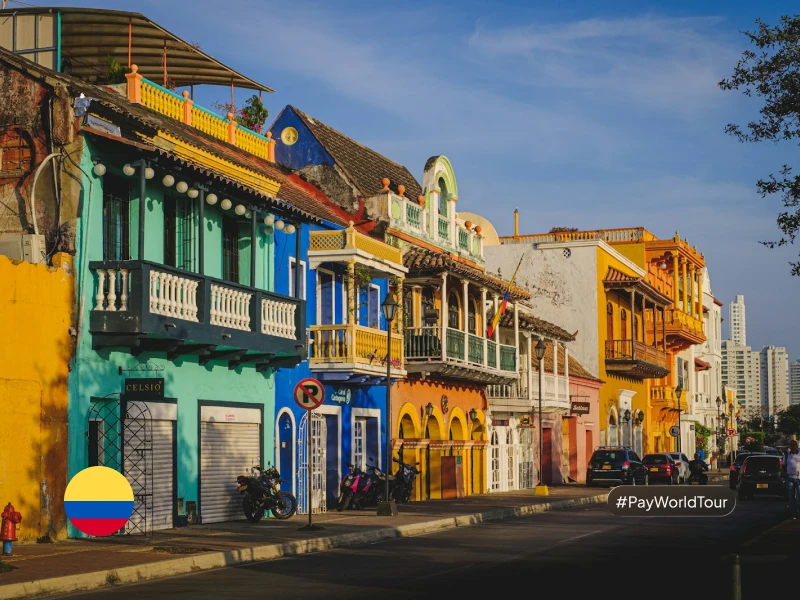

How people pay in Colombia in 2026
Colombia is in the middle of a fast switch from cash to account-based payments. Bre-B, the instant payment system run by Banco de la República, went live on October 6, 2025, and one year later it handled about 240 million transactions a month for 36 million users. Cash still matters: the share of Colombians who prefer it as a payment method fell from 91% in 2012 to 66% in 2026, according to Banco de la República survey data reported by Portafolio. Online, the Cámara Colombiana de Comercio Electrónico (CCCE) counted 684.6 million online sales transactions worth COP 145.4 trillion in 2025, up 19.9% in number.
Account debits, many of them through the PSE bank payment button, lead e-commerce, ahead of credit cards paid in installments (cuotas). Mobile wallets such as Nequi and Daviplata reach tens of millions of people, cash networks like Efecty serve those who stay offline, and local BNPL players such as Addi and Sistecrédito finance shoppers without credit cards. For merchants and their payment providers, a Colombian checkout needs PSE, cards with cuotas, wallets and, increasingly, Bre-B.
- 240 million Bre-B transactions per month in October 2026 (Portafolio)
- 684.6 million online sales transactions in 2025 (CCCE)
- 66% of Colombians prefer cash as a payment method in 2026 (Banco de la República via Portafolio)
- 15.7 million active credit cards in April 2026 (Superintendencia Financiera via La República)
Payment by card in Colombia
Colombia has no domestic card scheme. Banks issue Visa and Mastercard debit and credit cards, Bancolombia issues American Express cards under license, and Davivienda issues Diners Club. The Superintendencia Financiera counted 15.7 million active credit cards at the end of April 2026, led by Bancolombia, Banco Falabella, Davivienda, Nu and Davibank. Card use keeps growing: in 2025 the low-value systems that clear card payments recorded a 21% rise in value and a 19% rise in the number of operations, according to Banco de la República.
Online, credit cards carried 39.8% of e-commerce transactions and 35.9% of their value in 2025, second only to direct account debits. A Colombian specificity is that credit card purchases are split into cuotas, monthly installments chosen by the shopper at checkout, and gateways such as Mercado Pago offer interest-free cuotas on credit cards. Debit cards work online for many banks, but shoppers often prefer PSE for account payments. For PSPs, card routing and approval rates matter, and our guide to how card networks work explains the economics behind interchange fees.
Card schemes in Colombia
Visa

International scheme
The most widespread card brand in Colombia, on debit and credit cards from nearly every bank, used in stores, online and for tokenized phone payments.
Mastercard

International scheme
The second scheme in Colombia, issued as debit, credit and prepaid cards; Mastercard cards have been usable in Google Wallet in Colombia since August 2023.
American Express

Licensed scheme
In Colombia, American Express cards are issued by Bancolombia under license, from the no-fee Libre card to Platinum, and are accepted by major gateways.
Diners Club

Licensed scheme
Diners Club credit cards are issued locally by Davivienda and remain a standard option on Colombian checkouts, listed for example by Mercado Pago.
Credit cards with cuotas
Installment credit card
Colombian shoppers choose the number of monthly installments when paying by credit card, so card acceptance in Colombia means supporting cuotas.
15.7 million active credit cards at the end of April 2026, Superintendencia Financiera via La República
Debit cards
Debit card
Bank debit cards, mostly Visa and Mastercard, are the everyday card in stores and increasingly tapped from phones through Apple Pay and Google Wallet.
+19% growth in card payment operations cleared in 2025, Banco de la República
Payment by cash in Colombia
Cash is declining but it is still the default for many Colombians. Banco de la República says cash remains the instrument used for most routine payments, even as its use declines, and its survey data show that 66% of Colombians still preferred cash in 2026, down from 91% in 2012. The same Portafolio report links the recent drop to the rollout of Bre-B.
Online, cash is a niche but a necessary one. Cash payments made up 1.8% of e-commerce transactions in 2025, a figure the CCCE says includes cash on delivery. Shoppers without cards pay with a reference number at physical networks. Efecty, the largest, has 10,000 points covering 95% of the country and processed 47 million transactions in the first half of 2025. Other networks such as Su Red, Paga Todo and Gana add thousands of points. The Vía Baloto network, once common at checkouts, stopped operating in May 2022. Our article on the transition from cash to digital payments puts this shift in context.
Cash payment methods in Colombia
Cash
Banknotes and coins
Colombian pesos remain the most used instrument for everyday purchases, especially in small shops, transport and outside large cities.
66% of Colombians preferred cash as a payment method in 2026, Banco de la República via Portafolio
Efecty

Cash payment network
The leading cash network for transfers, bill payments and collections; online shoppers can pay with a reference at an Efecty point, an option offered by gateways such as Mercado Pago.
47 million transactions in H1 2025, including 27 million collections and payments, Efecty via La Nota Económica
Su Red, Paga Todo and Gana

Cash collection networks
Regional payment and collection networks, Paga Todo in Bogotá, Gana in Antioquia and Su Red nationwide, where people pay bills, collect transfers and top up accounts in cash. Su Red alone reported about 8,600 own points in 2018.
Cash on delivery
Cash on delivery
Paying the courier on delivery (contra entrega) is still offered by many online stores, particularly for first-time and unbanked buyers outside the main cities.
1.8% of e-commerce transactions paid in cash, including cash on delivery, in 2025, CCCE
Payment by bank transfer in Colombia
Account-based payments lead Colombian e-commerce. Direct account debits made up 46.5% of online transactions and 57.2% of their value in 2025, according to the CCCE. Most of them go through PSE, the payment button of ACH Colombia that redirects shoppers to their bank or wallet. PSE processed 236 million transactions in the first quarter of 2026, up 12% year on year, for online purchases, loan repayments and wallet top-ups.
Bre-B is the new layer. Banco de la República launched the interoperable instant payment system in 2025, and transfers work 24/7 with keys such as a phone number, ID number, email or alphanumeric alias, or with QR codes. One year after launch, it had 110 million registered keys and 246 connected entities. The central bank's own report shows instant transfers reached 2.5 times the number of traditional interbank transfers in 2025. The current cap is COP 12,110,000 per transaction in 2026. Our article on account-to-account payments explains why these rails matter for merchants.
Bank transfer methods in Colombia
PSE

Pay by bank
Pagos Seguros en Línea, run by ACH Colombia, lets shoppers pay online from a savings, checking or electronic deposit account at any connected bank or wallet, after a one-time registration.
236 million PSE transactions in Q1 2026, up 12% year on year, ACH Colombia via La Nota Económica
Bre-B
Instant payment
Banco de la República's interoperable instant payment system, live since October 2025, used for transfers between banks and wallets by key or QR code, and increasingly for merchant payments.
240 million transactions per month and 36 million users in October 2026, Portafolio
Bre-B QR payments
QR payment
Merchants could accept Bre-B QR codes from launch and individuals from the first half of 2026, according to Banco de la República. Wallets such as Daviplata scan QR codes regardless of the issuing bank.
ACH bank transfer

Bank transfer
Classic interbank transfers cleared by ACH Colombia and ACH Cenit, still used for B2B payments, invoices and larger amounts above wallet limits.
+15% growth in value cleared by the ACH systems in 2025, Banco de la República
Payment by installment and BNPL in Colombia
Paying in installments is a habit in Colombia, first through credit card cuotas and now through buy now, pay later providers that target people without credit cards. Addi, the largest, closed 2025 with 2.7 million active customers and 33,000 partner stores, and 47% of its users have no credit card. Its marketplace recorded 506,813 orders in the first half of 2026, with 7 out of 10 financed over three to six installments.
Sistecrédito, born in Antioquia, finances purchases at a large network of mostly small fashion, home and electronics stores, in person and online. Card-based options compete for the same shoppers: RappiCard, issued by Davivienda, offers 0% interest installment plans and up to 36 installments in the app, and gateways such as Mercado Pago advertise interest-free cuotas on credit cards. For merchants, offering both card cuotas and a local BNPL option widens the pool of shoppers who can complete a purchase.
Installment and BNPL providers in Colombia
Addi

BNPL
Colombia's leading BNPL provider, approved with an ID number and WhatsApp, used online and in stores to pay in up to 6 installments, or up to 24 for larger purchases.
2.7 million active customers and 33,000 partner stores in 2025, Addi via Latam Fintech Hub
Sistecrédito
Point-of-sale credit
Medellín-based fintech offering instant credit at partner stores, from fashion to appliances, with a strong presence in small and medium retailers and outside the main cities.
RappiCard

Installment credit card
The no-fee credit card of RappiPay, issued by Banco Davivienda, with 0% interest plans at partner brands and the option to reschedule purchases into installments in the app.
About 250,000 RappiCards issued by September 2025, RappiPay via Latam Fintech Hub
Credit card cuotas
Card installments
Bank credit cards let shoppers split almost any purchase into monthly cuotas chosen at checkout, often interest free at partner merchants or through gateways such as Mercado Pago.
39.8% of online transactions paid by credit card in 2025, CCCE
Payment by digital wallet and X-Pay in Colombia
Colombia's digital wallets started as financial inclusion tools and became mass-market payment apps. Nequi, now a financing company separate from Bancolombia, counts 27 million users in 2026, and Daviplata, from Davivienda, more than 19 million. Both work as Bre-B participants, PSE options, QR wallets and digital debit cards. Wallets carried 11.8% of e-commerce transactions in 2025 but only 5.5% of their value, a sign of frequent small payments.
X-Pay wallets are spreading in stores. Apple Pay works with Bancolombia debit and credit cards, and in December 2025 AV Villas added Google Wallet next to Apple Wallet, noting that nearly 60% of banked adults use their phone as their main payment method. Mercado Pago launched a digital wallet in Colombia in October 2024 linked to Mercado Libre, and Rappi's financial arm RappiPay keeps growing in accounts and cards.
Digital wallets and X-Pay in Colombia
Nequi

Mobile wallet
Grupo Bancolombia's digital platform, used for P2P transfers, PSE payments, QR payments and Bre-B transfers; the Botón Nequi lets merchants charge Nequi users directly.
27 million users in 2026, Valora Analitik
Daviplata

Mobile wallet
Davivienda's wallet, widely used for government transfers, with a payment button, PSE access, QR payments and a free digital debit card that can be added to Apple Wallet or Google Wallet.
19 million+ users in March 2026, Noticias RCN
Mercado Pago

Wallet and gateway
Mercado Libre's payment platform, which acts as a checkout accepting cards, PSE and Efecty, and since October 2024 as a consumer wallet topped up through PSE.
Apple Pay

Mobile wallet
Apple's wallet for contactless and in-app payments, supported by Colombian issuers such as Bancolombia, AV Villas and Daviplata's digital card.
Google Wallet
Mobile wallet
The Android wallet, available for Mastercard cards in Colombia since August 2023 and supported by banks such as AV Villas since December 2025.
Nearly 60% of banked adults use their phone as their main payment method, Valora Analitik
Payments in Colombia: FAQ
What is the most popular online payment method in Colombia?
Direct account payments, many of them through PSE. Account debits made up 46.5% of online transactions and 57.2% of their value in 2025, ahead of credit cards at 39.8% of transactions. PSE alone handled 236 million transactions in the first quarter of 2026.
What is Bre-B?
Bre-B is Colombia's interoperable instant payment system, operated by Banco de la República and live since October 2025. It moves money 24/7 between banks and wallets using keys or QR codes, and reached about 240 million transactions a month in October 2026.
Do Colombians still pay in cash?
Yes. Banco de la República survey data show 66% of Colombians preferred cash in 2026, down from 91% in 2012. Online shoppers without cards pay at cash networks such as Efecty, which has about 10,000 points.
Which BNPL providers are used in Colombia?
Addi leads, with 2.7 million active customers and 33,000 partner stores in 2025. Sistecrédito finances purchases at partner retailers, and many shoppers use credit card cuotas or cards such as RappiCard to pay in installments.
Accept local payments in Colombia with NORBr
In Colombia, Credibanco and Redeban process most card transactions, while Wompi, PayU and ePayco add PSE, wallets and cash. A PSP, PayFac, ISO or ISV should check PSE coverage, Bre-B readiness, cuotas and settlement in Colombian pesos.
With NORBr, you can connect any acquirer, PSP or local provider that offers PSE, Bre-B instant payments, Nequi and Daviplata, cash at Efecty and BNPL such as Addi. Some are already in our connector catalog; Mapper™ gets the others live in days, and Smart Checkout shows each shopper the right methods. Explore the other #PayWorldTour guides.
Local payment providers in Colombia
Wompi
Payment gateway
Colombian payment gateway backed by Bancolombia, serving online merchants and small businesses with checkout, payment links and a merchant app.
Covers: Cards, PSE, Nequi, Botón Bancolombia, Daviplata
PayU Colombia
Payment gateway
One of the longest-established online gateways in Colombia, serving e-commerce merchants with cards, bank transfers and cash payments in one integration.
Covers: Cards, PSE, Efecty
ePayco
Payment gateway
Colombian online payment gateway serving SMEs and larger merchants with checkout, payment links and subscriptions.
Covers: Cards, PSE, Efecty, Daviplata
Credibanco
Acquirer
Colombian payment network and acquirer that processes card payments for banks and merchants, with terminals and an online gateway.
Covers: Visa, Mastercard, American Express
Redeban
Acquirer
Colombian payment network and acquirer owned by local banks, providing card processing, terminals and digital payment services to merchants.
Covers: Visa, Mastercard, American Express