Explained to kids!
A merchant discount rate is the small share of every sale that a shop gives up so it can take card payments. The shop does not keep the whole price. A little piece goes to the people who carry the money safely from the buyer to the shop.
Let’s see it in real life…
Leila is 10 and lives with her two moms.
At the school fair, she sells lemonade for 1 dollar a cup.
Mr. Okafor runs the fair. He lends her a table, a banner and a locked cash box.
At the end of the day, he also counts the coins and brings them to each seller.
For this help, he keeps 5 cents on every cup.
Leila sells 40 cups. The cash box holds 40 dollars.
Mr. Okafor keeps 2 dollars and hands Leila 38.
“Do you keep all of my 2 dollars?” asks Leila.
“No,” he says. “One dollar goes to the school that owns the yard. Fifty cents pays for the tables. I keep the last fifty cents for my work.”
Leila thinks. Without the fair, she would have sold maybe five cups in front of her house.
That small share is a merchant discount rate.
Tiny recap
- It means… a small part of each sale that a shop pays to accept cards.
- It helps when… a shop wants to know how much money it really keeps from a sale.
- Watch out for… the share is not for one person. It is split between several helpers.
…detailed for specialists
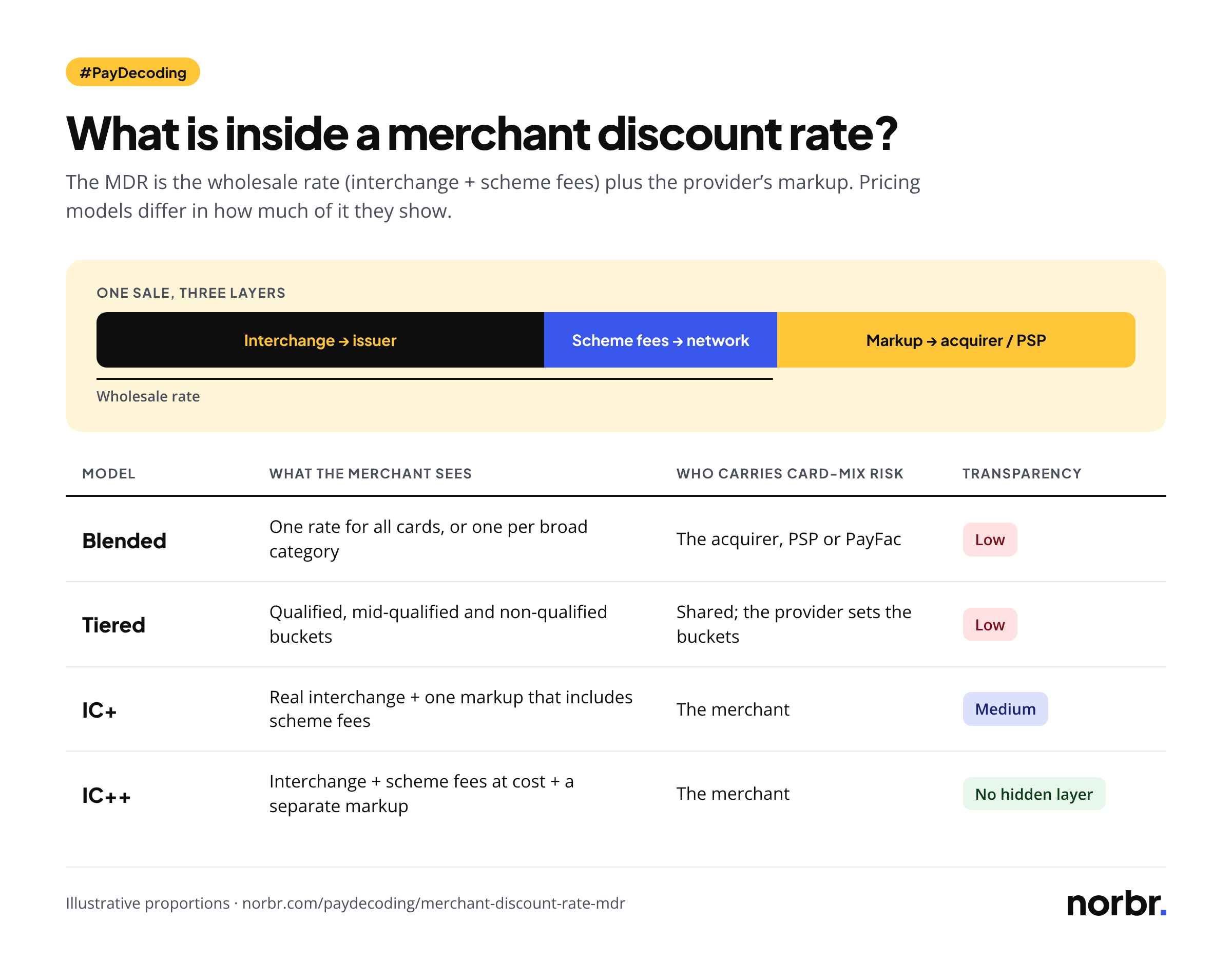
The merchant discount rate (MDR) is the total fee a merchant pays to accept a card payment, expressed as a percentage of the sale, often with a fixed amount per transaction. It bundles three layers: the interchange paid to the issuer, the scheme fees paid to the card network and the margin of the acquirer or PSP.
In 2026, the MDR is under pressure from every side. Regulators cap or review interchange in Europe, the UK, the United States and Australia, scheme fees keep growing, and merchants compare offers line by line. For PSPs, PayFacs and platforms, the MDR is both their price tag and their cost base, and the gap between the two is where their payment revenue is made or lost.
What is the merchant discount rate (MDR)?
The MDR is the price of card acceptance seen from the merchant’s side: for each sale, the acquirer settles the amount minus this “discount”. European law uses another name for the same thing. The Interchange Fee Regulation (EU) 2015/751 defines the merchant service charge (MSC) as a fee paid by the payee to the acquirer in relation to card-based payment transactions. MDR is the usual term in the United States, India and much of Asia, MSC in Europe and the UK.
Behind one rate sit three layers, each with its own beneficiary:
- Interchange: paid by the acquirer to the card issuer. It is set by the schemes, or capped by regulators, and varies by card type, read from the BIN, region and channel. See our episode on interchange fees.
- Scheme fees: paid to Visa, Mastercard or another network for assessment, authorization, clearing and cross-border services. See scheme fees.
- Acquirer markup: what the acquirer, PSP or PayFac keeps for processing, risk, service and profit.
Interchange plus scheme fees form the wholesale rate: the cost that every acquirer has to pay before it earns anything. The MDR is the wholesale rate plus the markup. Other charges, such as terminal rental, payment gateway fees, chargeback fees or monthly minimums, are usually billed outside the MDR, which is why two offers with the same headline rate can cost very different amounts.
Tiered vs blended vs IC++: how is an MDR quoted?
An MDR can be quoted in three main ways. They differ in who carries the risk that the card mix turns out more expensive than expected.
- Blended pricing: one rate for all cards, or one per broad category. Simple for the merchant. The acquirer or PayFac absorbs the differences between cheap and expensive cards, and prices that risk in.
- Tiered pricing: common in the United States. Transactions are sorted into buckets, typically qualified, mid-qualified and non-qualified, each with its own rate. The provider decides which transaction falls into which bucket, so the model is hard to audit.
- Interchange plus (IC+): the merchant pays the real interchange of each transaction plus one markup that includes scheme fees.
- Interchange plus plus (IC++): interchange and scheme fees are both passed through at cost, and the acquirer’s markup is shown separately. It is the most transparent model and the standard for large merchants.
In the EEA, transparency is the legal default. The regulation requires acquirers to offer and charge merchant service charges individually specified for different categories and brands of cards, unless the merchant asks in writing for a blended rate, and Article 12 requires that the merchant service charge and the interchange fee be shown separately for each transaction. Our episode on IC++ vs blended pricing compares the two extremes in detail.
How does the merchant discount rate work?
The MDR is not paid by invoice. It is deducted on the way, as the money moves from the cardholder’s bank to the merchant.
- Sale: a shopper pays 100.00 by card. The merchant’s PSP sends the authorization through the acquirer and the scheme to the issuer.
- Clearing: the transaction is cleared, and the scheme calculates the interchange according to the card, the channel and the countries involved.
- Issuer to acquirer: the issuer pays the acquirer the transaction amount minus interchange, for example 100.00 minus 0.20 for an EU consumer debit card.
- Scheme billing: the scheme bills its fees to the acquirer, partly per transaction, partly in monthly or quarterly invoices.
- Acquirer to merchant: the acquirer settles the merchant. With net settlement, it pays 100.00 minus the MDR. With gross settlement, it pays 100.00 and collects fees later, usually monthly.
- PayFac layer: when a PayFac or platform sits in between, it receives funds from the acquirer at its own buy rate, then pays sub-merchants at the sell rate it has set.
- Statement: the merchant receives a statement. Depending on the pricing model, it shows one rate or the three layers.
A simple illustration, with round numbers chosen for the example: on a 100.00 sale paid with an EU consumer credit card, interchange is capped at 0.30. If scheme fees come to 0.10 and the acquirer’s markup to 0.40, the MDR is 0.80, and the merchant receives 99.20. Change the card to a commercial card from another region and only the first two lines move, but they can more than double the total.
The buy rate and the sell rate are two different MDRs for the same transaction. The first is what the operator pays its acquirer. The second is what the merchant pays the operator.
The MDR in numbers (2026)
Dated figures give the order of magnitude of each layer.
- 1.59%: weighted average processing fee paid by US merchants in 2025, or USD 198.25 billion, up from USD 187.20 billion in 2024, according to the Nilson Report.
- 0.2% and 0.3%: EU caps on consumer debit and credit interchange, the floor under any European MDR, as summarized by EUR-Lex.
- More than 25%: real-terms increase in Mastercard and Visa core scheme and processing fees between 2017 and 2023, costing UK businesses at least GBP 170 million a year, according to the UK Payment Systems Regulator.
- 1.15% and 1.5%: caps on online payments made in the EEA with non-European consumer debit and credit cards, against 0.2% and 0.3% in store (see card-present vs card-not-present), under commitments that Visa and Mastercard extended until November 2029.
- 21 cents + 0.05%: US cap on debit interchange for large issuers, plus a 1-cent fraud-prevention adjustment, under the Federal Reserve’s Regulation II.
- October 1, 2026: date from which the Reserve Bank of Australia removed surcharging on eftpos, Mastercard and Visa cards and lowered interchange caps, per its March 2026 decision. Merchants there can no longer pass the MDR on to cardholders.
What are the limits and risks of the MDR?
A single percentage hides a lot. The main risks come from what the rate does not show.
- Opacity: a blended or tiered rate does not tell the merchant how much goes to the issuer, the scheme and the provider. Savings from a regulatory cap may never reach the merchant.
- Card mix risk: commercial, premium and foreign cards cost more. A provider that quotes a blended rate on an optimistic mix loses money when the mix shifts.
- Uncapped layers: interchange is capped in several regions, scheme fees are not. They change several times a year and are hard to forecast.
- Fees outside the rate: authorization fees on declined payments, refunds, chargebacks, cross-border and currency conversion are often billed separately.
- Cross-border exposure: the EU cap does not cover commercial cards, three-party schemes or cards issued outside the EEA. One international customer base can double the wholesale rate.
- Regulatory moves: a zero or capped MDR set by a government, a surcharging ban or a new cap can change a provider’s economics overnight.
The MDR: what changes for PSPs, PayFacs and platforms
For an operator, the MDR is a product to design, not just a rate to quote. Five areas matter most.
Pricing design
Operators choose a model per segment: blended for small merchants who want predictability, IC++ for larger ones who want proof. The choice has to follow the data. A platform should know its wholesale rate per merchant, per card type and per channel before it promises a single rate. A blended rate should also be reviewed on a schedule, because scheme fee changes and shifts in card mix slowly erode a margin that looked safe on the day the contract was signed. The levers on the cost side are listed in payment processing fees: a money-saving guide.
Onboarding
The expected card mix belongs in the onboarding file: share of commercial cards, share of foreign cards, average ticket, in-store versus online. These inputs decide the rate a PayFac can afford to offer and the reserve it may need. In France, for example, most cards are co-badged with the domestic scheme, which changes both routing and cost, as the guide to payment methods in France explains.
Routing
Routing changes the wholesale rate. Co-badged cards can be sent to the cheaper network where the merchant has that choice, US debit can be routed to one of two unaffiliated networks, and a local acquirer avoids cross-border assessments. This is the logic of multi-acquiring, applied through routing rules. Some operators go further and connect to the schemes themselves, a path discussed in direct-to-scheme processing for PSPs and acquirers. Choosing partners market by market is covered in finding the right acquirer for cross-border payments.
Reconciliation
Each acquirer reports fees in its own format, sometimes weeks after the transaction. Operators need to match fees to transactions to know their real margin. In NORBr, reconciliation and settlement data from the connected providers is consolidated on one platform, and analytics dashboards let an operator follow volumes and fees by merchant, provider and payment method.
Merchants judge a provider by its statement. One that shows interchange, scheme fees and markup per transaction, or at least per card category, answers most pricing questions before they are asked, and it meets the European transparency rules by design.
Revenue model
The spread between buy rate and sell rate is the core of an operator’s payment revenue. It grows with volume, but also with better routing, lower dispute costs and added services billed on top of the MDR.
For a merchant-side view of the same costs, the Payments Library lists Payments from a merchant’s perspective: a European assessment. The #TheShot episode Direct connection: lower costs, more control looks at how the cost stack changes when intermediaries are removed, and why merchants connect directly to card schemes gives the merchant’s reasons.
Is a low MDR the right goal in 2026?
Not on its own. The right goal is an MDR that each party can read and explain. What it means by player:
- PSPs: compete on transparency and on the wholesale rate they can reach through routing, more than on headline price.
- PayFacs: blended pricing remains the product, but it must be backed by per-transaction cost data to stay profitable.
- ISOs: margins on resold rates are thin. Value moves to service, reporting and added products.
- ISVs and platforms: payments become a revenue line once the platform controls the sell rate and sees the buy rate.
The merchant discount rate is the sum of interchange, scheme fees and a markup, and an operator that can see all three for every transaction can price with confidence instead of guessing.
Frequently Asked Questions
What is the merchant discount rate (MDR)?
The merchant discount rate (MDR) is the total fee a merchant pays to accept a card payment, shown as a percentage of the sale, often with a fixed amount. It combines interchange paid to the issuer, scheme fees paid to the card network and the acquirer’s or PSP’s margin. In Europe it is called the merchant service charge.
What is the wholesale rate in card processing?
The wholesale rate is the cost of a card payment before any provider margin: interchange paid to the issuer plus scheme fees paid to the card network. Every acquirer pays it. The merchant discount rate equals the wholesale rate plus the markup of the acquirer, PSP or PayFac.
What is the difference between tiered, blended and IC++ pricing?
Blended pricing charges one rate for all cards. Tiered pricing sorts transactions into qualified, mid-qualified and non-qualified buckets, each with its own rate. IC++ pricing passes interchange and scheme fees through at cost and shows the provider’s markup separately, which makes it the most transparent of the three.
Why is cross-border interchange higher than domestic interchange?
Cross-border interchange is higher because issuers and schemes price in more fraud risk and currency handling, and because regional caps often stop at the border. In the EEA, consumer cards are capped at 0.2% and 0.3%, while non-European cards used online can reach 1.15% for debit and 1.5% for credit.
Does the EU interchange cap apply to every card payment?
No. The EU interchange cap of 0.2% for debit and 0.3% for credit applies to consumer cards issued and used in the EEA. It does not cover commercial cards, three-party schemes such as American Express in most cases, cards issued outside the EEA or cash withdrawals at ATMs.